


We thought it would be useful to look back at a wide range of research from 2023 and 2024, just as it became clear that AI was about to change everything, and ask where those early forecasts ended up being right, wrong, or simply too conservative.
This retrospective draws on a wide range of research from third party sources as well our own. Much of that work saw AI coming. The largest misses came from underestimating how quickly the pieces around the accelerator would have to scale together. Something we now refer to as the GPU Tsunami.


How much the market moved
Four years early: A 2022 forecast put the semiconductor market at $1 trillion in 2030 (historical framework). Our current model reaches $1.79 trillion in 2026 and $3.49 trillion in 2030. Adding adjacent AI infrastructure brings the combined 2030 silicon-systems pool to $3.95 trillion.
5.8 times: Our 2027 accelerator model is now $720 billion, compared with an old $125 billion AI-compute endpoint.
60%: One quarter of NVIDIA Data Center revenue reached about 60% of the old full-year 2027 AI-compute endpoint.
2.7 to 3.2 times: The 2025 CoWoS capacity estimate was revised from 25,000 to 30,000 wafers per month to more than 80,000.
79%: The 2027 AI-switching endpoint was revised higher in less than a year.
3.0 to 3.6 times: Current frontier rack power surpassed an old 2030 expectation four years early.
2.4 times: Our seven-company 2027 capex model is already 2.4 times an old global data-center endpoint.
We think its important to look back, as a post mortem, to understand where the analysis went wrong and what the collective industry (us analysts) underestimated, so we can recognize those patterns when they appear again. Some earlier calls were right, while others moved too quickly on adoption timing. We also missed how much the unit of analysis was changing as the market developed. We were particularly too conservative on the ASP expansion across the semiconductor supply chain. We fully modeled semiconductor output based on our foundry capacity model, but we did not fully appreciate the pricing leverage created by the AI infrastructure cycle. Our midpoint scenario implies the industry’s blended semiconductor ASP rises from approximately $0.75 today to more than $2.10 by 2028, nearly tripling in just three years. Between 2025 and 2028, we estimate semiconductor unit shipments increase only 25–30%, while the average semiconductor ASP increases nearly 185%, driving approximately 260% industry revenue growth. This represents a structural shift in semiconductor industry economics as value per device compounds substantially faster than industry unit shipments. We map every constraint in the below report leading to this ASP increase, in the era we now call the era of margin expansion.

What the archive saw, and where its boundary failed
We reviewed a broad set of historical forecasts to understand how expectations changed over time. Licensed historical work is described as third-party forecasts or archive estimates, while current comparisons use public outcomes and Creative Strategies models.
The scorecard separates outcomes, run rates, and model revisions. A newer forecast shows expectations moving; only an outcome proves the old forecast wrong.
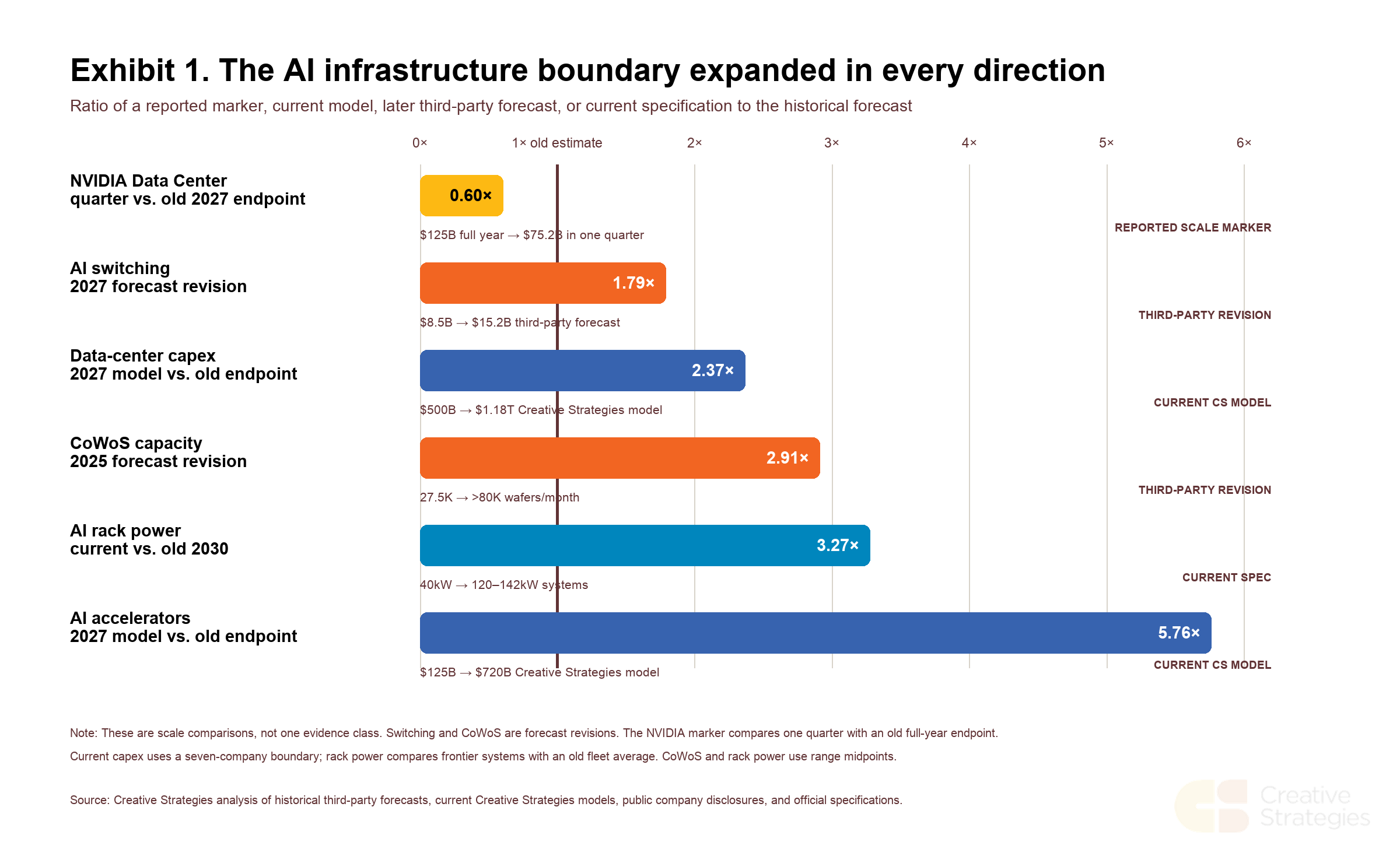
Each row uses a different type of evidence, but the pattern is consistent. The largest forecast revisions appeared once the market moved beyond the accelerator and began modeling the complete AI system. Compute only becomes usable capacity when the full rack can be commissioned. The early forecasts treated the infrastructure around the accelerator as a supporting input. It turned out to be part of the market itself.
Compute demand escaped the original boundary
In March 2023, a third-party forecast assumed that 40 to 60 large-model builds over the following 12 to 24 months would create approximately $10 billion to $15 billion of incremental GPU TAM. A June 2023 custom-silicon model put AI computing semiconductors at roughly $43 billion in 2023, growing to $125 billion in 2027, with custom ASICs reaching as much as 30% of cloud AI semiconductor spending.
Those estimates were aggressive at the time, but their boundary was still too conservative. The model counted likely builds and the accelerators required, then extended the curve as custom silicon gained share. It did not capture the wider inference market that would form around installed compute. Ultimately, what most got wrong was underestimating the compute intensity of the workload that is agentic AI. We think many still under appreciate this today as well.
NVIDIA reported $75.2 billion of Data Center revenue in Q1 FY2027. Data Center includes systems and networking, so it is not like-for-like with semiconductor TAM. Even so, that quarter reached 60% of the old 2027 AI-compute endpoint. In one quarter, NVIDIA generated revenue equal to 60% of what the earlier model expected from the entire AI-compute market for all of 2027. Looking forward, our current model puts merchant GPU and XPU logic plus custom AI accelerators at $770 billion in 2027 and $1.36 trillion in 2030.
The models underestimated how much demand each new accelerator would create. Training built the installed base, while better performance expanded the market for inference. That pulled custom silicon and rack-scale systems into what had started as a GPU market. As supply grew, the TAM grew with it.
Packaging was the clearest under call
In August 2023, a third-party advanced-packaging forecast put industry CoWoS capacity at roughly 15,000 wafers per month, rising to 20,000 to 25,000 in the second half of 2024 and 25,000 to 30,000 in 2025. The forecast saw little likelihood that CoWoS would remain a meaningful bottleneck beyond 2024.
By January 2025, a later archive model expected TSMC CoWoS capacity to exceed 80,000 wafers per month by the fourth quarter of 2025. That was 2.7 to 3.2 times the 2023 estimate for the same year. In July 2026, TSMC still described packaging as tight enough to limit customer growth. TSMC Q2 2026 materials.
In retrospect, what was missed was the timing, pull-in, of chiplet designs as AI accelerators were the first evidence of the broad shift from monolithic to systems based chip design.
Packaging became part of the capacity boundary, which is the central idea in our report The GPU Tsunami: TSMC, Intel, and Samsung Foundry. A leading-edge wafer becomes useful AI capacity only after advanced packaging brings it together with HBM and the rest of the rack.
Memory became a much larger market than the models allowed (and structural)
Memory was not missing from the early forecasts. It was treated as a cyclical recovery. In late 2023, the public market forecast called for roughly $130 billion of memory revenue in 2024. Actual sales reached $165 billion, 27% above that estimate.
The longer-range forecasts were even more conservative. One public model published in 2024 put combined DRAM and NAND revenue at approximately $206 billion in 2025 and just $214 billion in both 2026 and 2027. The assumption was that the recovery would level off once pricing normalized.
Our current model looks very different. We estimate combined DRAM and NAND revenue of $230–240 billion in 2025, $550–570 billion in 2026, and $800–850 billion in 2027. Against the old forecast, the 2026 market is now modeled at 2.6 times the prior estimate. By 2027, the difference reaches approximately four times.
This is a forecast revision, not yet a realized outcome, yet trending in that direction. But it shows what the earlier models missed. AI did not create demand only for HBM. It increased the amount of server DRAM and enterprise NAND required around each accelerator. At the same time, HBM consumed capacity that would otherwise have served conventional memory. The result was a much broader shortage and a much larger market than the original forecasts allowed.
The bottleneck kept moving
The early work saw the constraint moving beyond the accelerator, but underestimated how quickly the network and site would control the deployment schedule.
A June 2023 forecast put 2027 AI-switching revenue at $8.5 billion. Eleven months later, that endpoint had risen 79% to $15.2 billion. Our broader networking-silicon model now reaches $105 billion in 2027. The categories differ, but reported revenue confirms the direction: Broadcom’s $10.8 billion of quarterly AI semiconductor revenue reached 77% of its old full-year FY2025 forecast. Broadcom Q2 FY2026 results.
Power moved faster still. A July 2024 note expected average rack density to reach 40 kilowatts by 2030. GB200 and GB300 systems reached 120 to 142 kilowatts four years early, or 3.0 to 3.6 times the old endpoint. These are frontier systems rather than fleet averages, but they set the next building standard. GB200 specification and GB300 reference architecture.
Capex followed. A May 2024 model put global data-center capex at $500 billion in 2027. Our seven-company cost-adjusted base now reaches $1.18 trillion, or 2.4 times that endpoint.
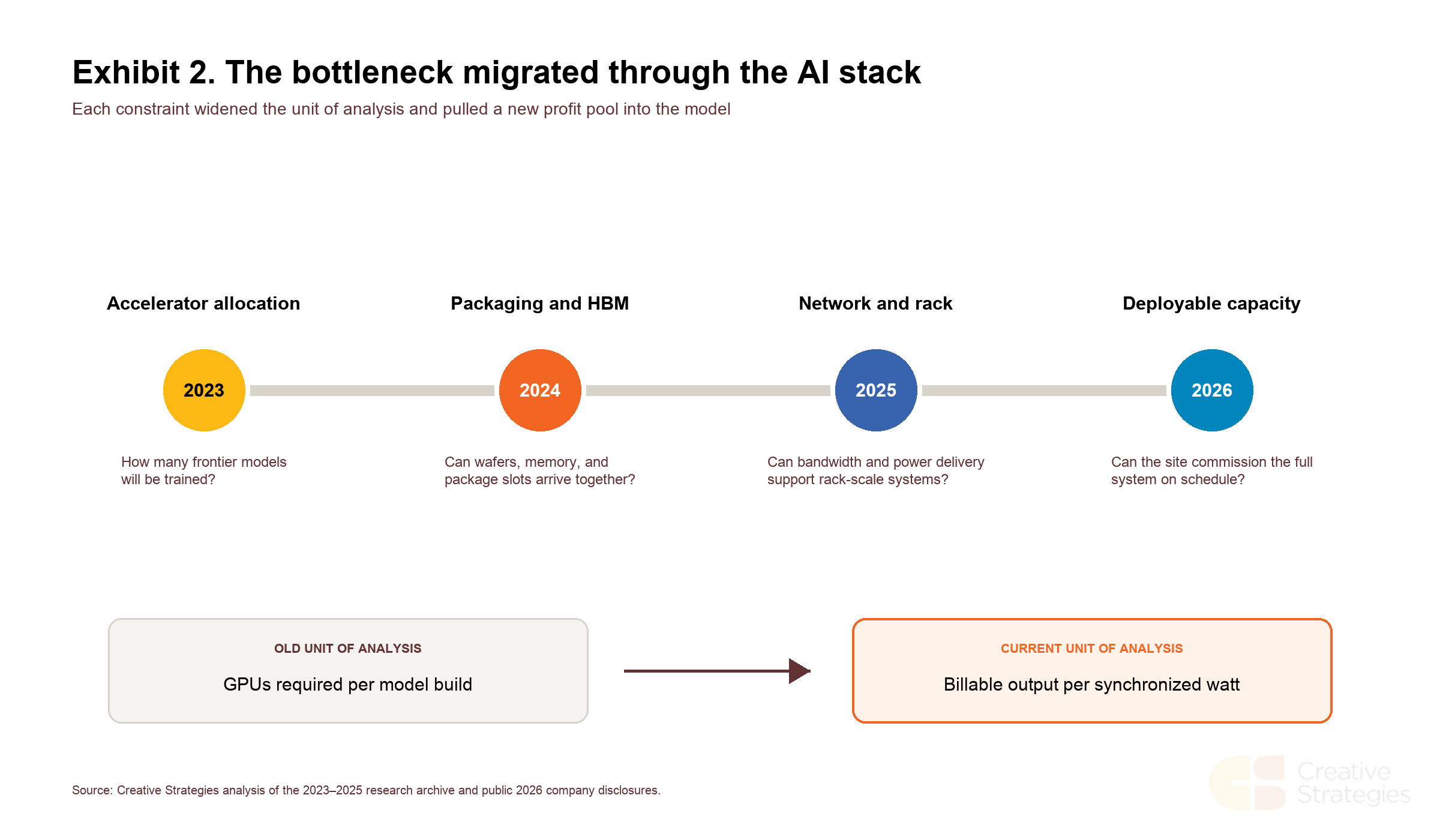
The bottleneck moved from the chip into the network and then the site. Each fix exposed the next constraint. That is why Counting Real AI Capacity and Gigawattonomics focus on commissioned systems and economic output per watt. Until the full system is commissioned, announced capacity remains intent.
The top line hid the infrastructure reallocation
A January 2024 semiconductor model forecast sales of $645 billion in 2024 and $718 billion in 2025. WSTS reported $630.5 billion and $795.6 billion, respectively. The model was 2.3% high for 2024 and 10.8% low for 2025. WSTS 2025 result. It caught the recovery but missed the next acceleration in memory pricing and AI-infrastructure mix.
Public cloud was also broadly on track. A June 2024 model forecast spending rising from roughly $675 billion in 2024 to $1.38 trillion in 2028. The surprise occurred inside the total as AI infrastructure grew faster and carried more capital intensity than conventional workloads.
A top-line forecast can land within normal error while the internal demand map changes enough to redirect capital, capacity, and profit. The semiconductor and cloud totals did not reveal how much of the next dollar would be pulled toward accelerators and the infrastructure required to deploy them.
Enterprise AI had two opposite forecast errors
Infrastructure estimates were generally too small. Enterprise adoption produced two errors in opposite directions. Spending and usage intensity ran above the early markers, while scaled-production timing was sometimes too aggressive.
Two 2023 third-party forecasts framed an $820 billion enterprise-software TAM and approximately $150 billion of GenAI software spending within three years.
Our current working range puts enterprise GenAI spending across software, services, and inference compute at $175 billion to $200 billion in 2026, rising to more than $600 billion by 2030. The boundary is broader than software alone, so the comparison is directional. Even with that caveat, the 2026 midpoint is about 25% above the old three-year marker, and the decade-end range is more than four times as large.
The survey archive explains the other error. A 2024 IT survey found 52% of respondents live with at least one AI use case, but only 10% in production at scale. Later CIO surveys measured production at 30% in 2024 and 39% in 2025, while an earlier CTO survey expected nearly universal use by year-end 2024.
The error was treating a company with one live use case as equivalent to a company that had reorganized a production workflow. An enterprise can pay for AI and increase token consumption while only a small number of workflows reach scaled production. In our report, From AI Usage to AI Earnings Power picks up there. The test is whether repeated use changes a measurable operating baseline enough to earn a durable budget.
Where the current Diligence Stack work goes next
The current research starts from this revised unit of analysis. Counting Real AI Capacity establishes what has actually been commissioned. Gigawattonomics then asks whether that capacity can earn an acceptable return from the power it consumes.
Below the site, The GPU Tsunami applies the same capacity discipline to foundries. Where AI Constraints Become Pricing Leverage asks which shortages can support durable economics rather than temporary scarcity pricing. The memory and enterprise reports carry the method into capacity allocation and workflow monetization.
Bottom line
As a firm that has been doing market models, forecasting, sizing, and more for over 40 years, we understand being conservative, and how forecasts are almost always wrong. A forecast is only as good as the underlying assumptions we stay in a state of constant learning, observing, and looking for the right past and present patterns in order to continually strengthen our assumptions on every part of the industry we research.
We shared a lot of our internal forecasts and models in the look back, knowing full well they may be wrong and also pose the scenario, within the historical view, that what if even today we are not bullish enough.
For subscribers
Below the paywall, we share our notes from attending AMD Advancing AI and having time with management to discuss products and strategy and Intel earnings with feedback from our calls with IR. The Intel note explains why the earnings recovery may arrive before an external foundry win, with custom ASICs emerging as another business to watch. The AMD note looks at Helios and whether its open rack-scale design can turn strong component technology into a coherent system.
