


We have been early on the demand side of the AI funding debate this year, tracking who pays for AI alongside how much compute gets built. That work now runs through our models. Bull and bear cases for AI monetization run in parallel against the accelerator demand we forecast and the pricing and gigawatt capacity we track. As enterprise and consumer software spending on AI begins to ramp, we want to know as much as anyone whether AI can fund itself.
The bear case rests on a range of consensus estimates (which we model as well): the industry will spend roughly $9.6 trillion on AI data centers between 2024 and 2030, while the AI revenue we can track over 2026 to 2030 adds up to about $4.1 trillion.
The bear case is fair on one point: the spending is real, and most of it lands years before the revenue does. We think the comparison still asks the wrong question. Hard assets are paid for once and expensed over their useful life. AI revenue is recurring and, so far, compounding. The fairer test is whether each year’s AI revenue covers each year’s cost of owning the fleet: depreciation on the hardware, the power to run it, and a reasonable return on the capital tied up in it. A lender would underwrite the fleet the same way, and we run that test here with the connected models in the CS Forecast Stack.
On that basis, our view is that AI does pay for itself, but later than the optimists hope and for different reasons than most of the debate assumes. We forecast in ranges, and we show them here, because the spread is as informative as the central number.
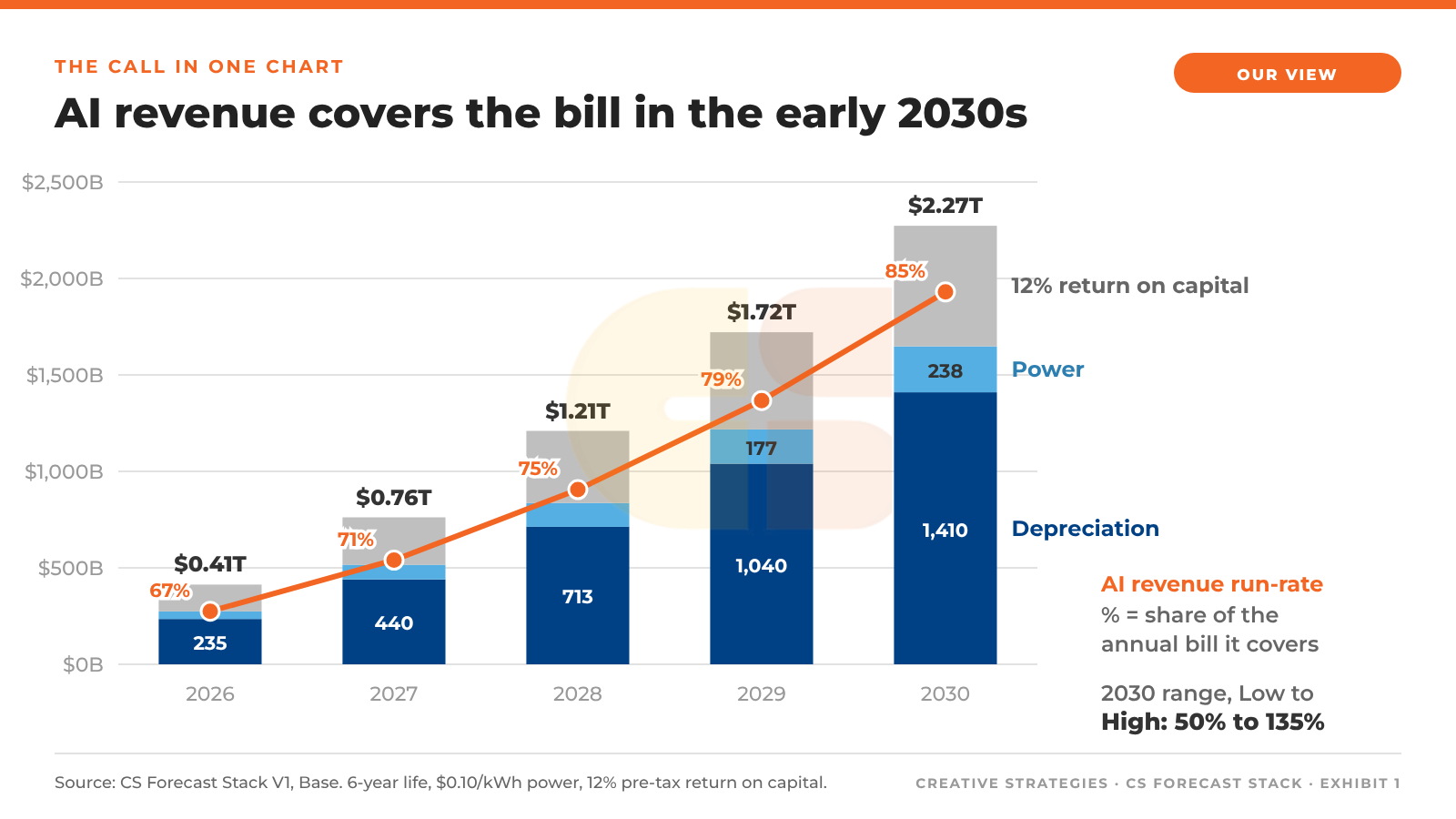
In our central scenario, revenue covers about two-thirds of the bill today and about 85% by 2030. We estimate the annual cost of owning the global AI fleet rises from about $0.41 trillion in 2026 to about $2.27 trillion in 2030. Tracked AI revenue, measured as an end-customer run-rate, rises from about $275 billion to about $1.93 trillion over the same period. Coverage improves every year, from 67% to 85%, and if revenue keeps growing faster than the fleet after 2030, the two lines cross in the early 2030s. Across our Low and High scenarios, 2030 coverage spans roughly 50% to 135%, so adoption carries most of the uncertainty, and in the Low scenario we would not expect a crossover this decade.
The unit economics already work. A gigawatt of AI capacity costs roughly $34.5 billion to build and equip. When that gigawatt is rented for inference, it recovers its cost in about three years at our central rental price, and in roughly two to six years across our price range. The problem is the average gigawatt, which takes about seven years to pay back, longer than the six-year life we give the hardware.
The gap sits in absorption. In our central 2030 forecast, about 42% of AI capacity is paid for by revenue we can track. Roughly 37% trains models, and the remaining 21% runs inference that nobody bills as AI revenue: ad ranking, search, recommendations, free consumer tiers, and assistants bundled into other products. Very little of it sits idle. Much of it is monetized in ways that never appear on an AI revenue line, and our first estimate of its value, roughly $0.35 trillion to $0.48 trillion a year, would lift 2030 coverage to about 100% to 106%.
Absorption and pricing close the gap, and accounting only narrows it. An eight-year hardware life lifts 2030 coverage to 96% and 10% less capex to 92%, while half the fleet earning rent, or agents lifting revenue per gigawatt by about 20%, each clears 100% on its own.
For investors and stakeholders, the question becomes which of those levers moves first. Our thesis is that agentic workloads move both demand levers: they raise the share of capacity doing billable work, and they are increasingly priced on work completed instead of tokens consumed (we have modeled price by tokens consumed as well). The weak link is the frontier labs, where compute absorbs roughly 80% of revenue in our forecast and outside capital funds most of the buildout they anchor.
What subscribers get in the full note
How we build the annual bill, and why a return on capital belongs in it
Who pays: the 2030 revenue mix, and why consumer subscriptions are only about 4% of it
Unit economics per gigawatt, and why $50 billion cost estimates do not break the case
Our first sizing of the unbilled 21%, and how far it pulls the crossover forward
What the Low and High scenarios assume, and what would have to be true for each
Who carries the risk, from hyperscalers and neoclouds to labs and suppliers
Three connected models. This analysis ties together three models in the CS Forecast Stack. The AI Accelerator Market Outlook sets the spending path and the installed fleet, including how much of it trains models. AI Factory Power & Economics turns that fleet into gigawatts, energy, and the economics of a rented gigawatt. The AI Revenue Tracker supplies revenue, lab finances, and the Low and High scenarios. Atlas subscribers can open each model, see every forecast in all four scenarios, and query them with the Atlas research agent.
Companies discussed, by where they sit in the risk: hyperscalers (Microsoft, Alphabet, Amazon, Meta, Oracle); neoclouds (CoreWeave, Nebius); frontier labs (OpenAI, Anthropic, xAI); suppliers (NVIDIA, AMD, Broadcom, TSMC, SK hynix, Samsung, Micron).
