


Our firm has studied every major technology adoption cycle over the past several decades. A foundational part of that research has been understanding the customer who gives the earliest and most informative signals of a technology’s value, the pain points it solves, and the opportunities that begin to form. As much as we research AI through infrastructure trends, technological innovation across hardware, and the models themselves, we keep coming back to the customer required for this entire AI buildout to be successful and sustainable: the enterprise.
For those of us who have seen many different technology adoption cycles, the patterns that make the AI buildout still look like an immature market are familiar. Some parts of the market begin to show consistency, while the technology, standards, processes, or protocols remain far from settled. This is particularly true in early enterprise adoption. Even among the businesses moving most aggressively, more questions than answers remain. This report updates our E/AI Index CIO/CTO survey through our most recent channel checks across the areas that report highlighted as open questions, along with our most up-to-date observations from recent enterprise AI fieldwork conversations with decision makers on AI deployment.
The May E/AI Index showed where budgets were forming. This update follows them into production
That customer work formed the basis of our May E/AI Index CIO/CTO report. Our survey across a cohort of CIO/CTOs showed that AI had become a staple of enterprise IT budgeting. The survey revealed the clearest ROI was showing up in what we articulated as bounded workflows. These are repeated tasks with a clear result and an existing baseline, which lets the company compare cost and quality before and after AI. Agent deployment was also running well ahead of broad production and still is today. Budget formation is also a key metric we are tracking, as we want to continue to see AI become budget additive vs. take away from other areas scoped dollars.
The main change since the May E/AI Index is the move into what we would call governed production. This is the point where an AI workflow leaves the relative safety of a pilot and starts operating inside the business under defined rules. Companies are now learning whether the value they saw in a controlled test holds when the workflow reaches more employees and touches more company systems. That wider use is exposing the upgrades required across the technology stack and internal processes before AI can move into more of the enterprise.
Governed production also gives management a much clearer view of the cost and risk attached to each workflow. Usage begins to shape which model is worth paying for, while company data has to reach the agent in a form it can use without losing the access rules around that information. The authority given to the agent then determines how much of the workflow it can complete on its own. Our fieldwork suggests this is where most enterprises sit today: the workflow is live, while companies are still building the cost controls and governance required to expand it safely.
Governed production is happening workflow by workflow
The same company can be at very different stages of adoption depending on the work being done. Coding may already be running at scale because the work is measurable and review is built into the process. A finance agent may remain under tight human control because an error can reach a system of record or affect an important business decision. This is why we look at enterprise adoption at the workflow level. Both the risk and the economics change with the work, and those conditions determine how much authority the company is willing to give the agent.
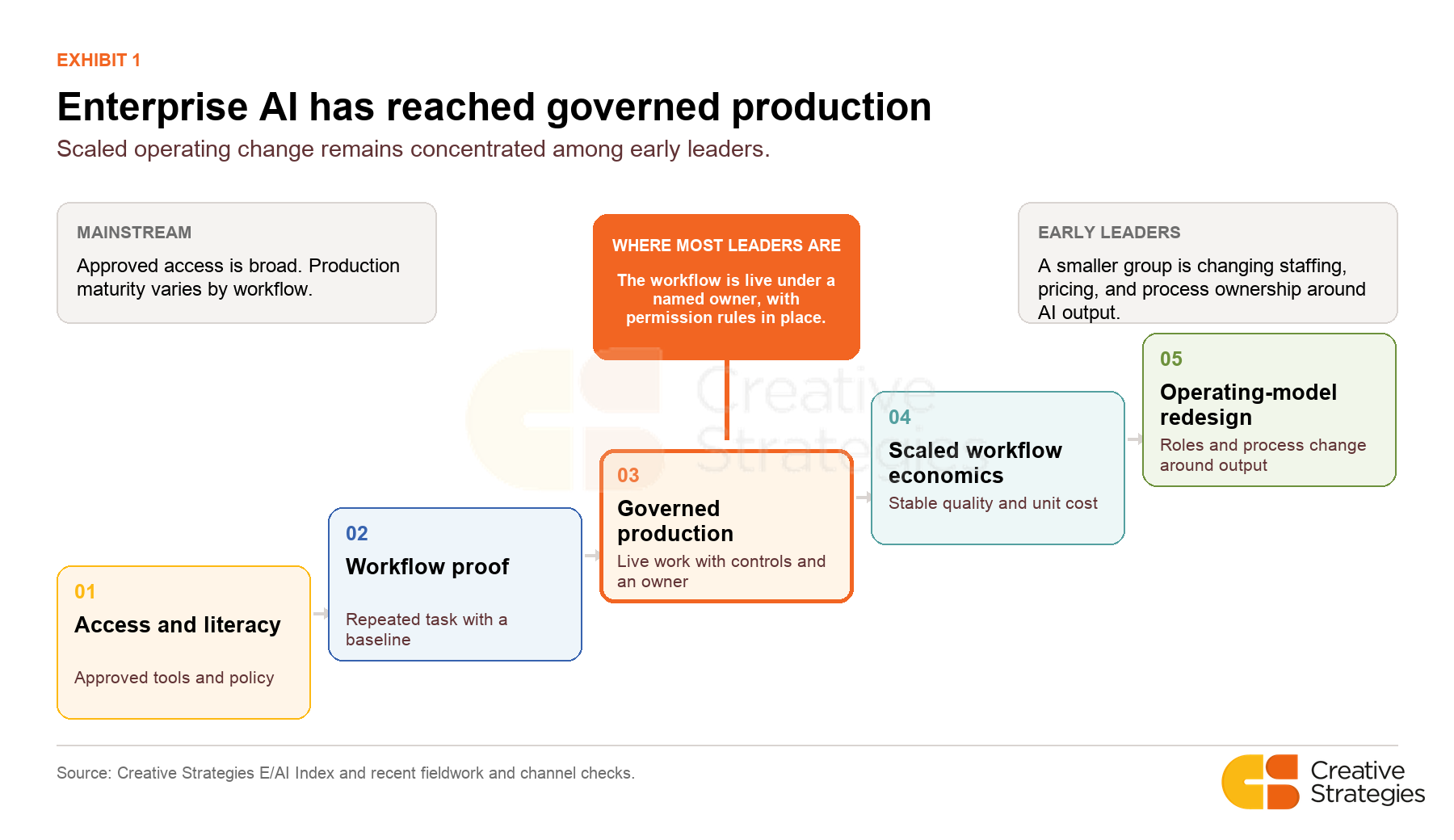
Exhibit 1. Enterprise AI has reached governed production, while scaled operating change remains early. Note: Qualitative Creative Strategies adoption-cycle synthesis. Stages describe operating maturity; the exhibit does not estimate a pooled survey distribution. Source: Creative Strategies analysis of enterprise CIO conversations and field checks through August 2026.
Our checks show that the companies furthest along are beginning to put a clear operating structure around each production workflow. A named owner sets the permission rules and determines how problems are escalated, which is what moves the workflow into governed production. The next proof point is whether the economics continue to hold as more employees use the workflow and the system completes a larger share of the work. Few companies have reached the point where AI-created capacity changes how jobs are designed or which software and outside services they continue to pay for. Those decisions would be stronger evidence that AI is beginning to change how the company operates and spends.
Companies are now managing the cost of production use
Our second-half checks also show that production is forcing CIOs to measure what it costs to complete a workflow. IT decision makers are counting model calls and asking where a premium frontier model creates enough economic benefit to justify the token cost. Our favorite quote is, “You don’t need to pay frontier model costs to summarize a Teams meeting.” Other areas may have clear value, such as coding and customer service, which have moved faster because the work already has a measurable baseline. Workflows without one will face more scrutiny, increasing demand for systems that route each request to the right model.
The economics also depend on whether the agent can reach the right company information while work is happening. Most enterprise data was organized for storage or later reporting. A production agent needs current context inside the workflow and has to preserve the access rules attached to it. Our checks keep coming back to this as one of the clearest ways production is exposing how much work remains across enterprise data systems. We detail that coming storage challenge in the report below.

Data sovereignty is also shaping model choice. Most workloads still run through closed frontier models in the cloud because they produce the best results on difficult work. Open-weight models are entering through cost-sensitive workflows, although interest still runs ahead of production use. Enterprises want to keep company context and workflow records under their control so they can change models without rebuilding the process. A credible open option gives them more choice when closed-model costs rise. We think that cloud-led pattern also creates a premium inference tier (good for Cerebras and NVIDIA Groq), particularly in workflows where lower latency increases completed work enough to justify paying for faster tokens on top of frontier-model pricing.
CIOs and CISOs are tightening control over who can create an agent and how much authority it receives. Companies still rely on human review across most production workflows because the controls around agent actions remain incomplete. Wider deployment now depends on whether companies can hold quality while improving the cost per completed task. Human review also has to grow more slowly than the amount of work the system completes.
Inside the Full Update
Why governed production now best describes enterprise AI adoption and what changed once approved budgets reached live workflows
Where companies sit in the five-stage adoption cycle and what still separates production from scale
How CIOs are measuring the full cost of completing a workflow instead of relying on seats or token growth
Why control of company context gives enterprises more flexibility across closed and open-weight models
How permission rules and auditability determine the authority companies are willing to give an agent
Why cloud-led deployment can create a premium inference tier even as some workloads move back on premises
