


Check out CS Atlas and exclusive research product built on Creative Strategies research and available to subscribers.

More suppliers can participate in the same program
The custom ASIC market has become more diverse and competitive as customers mix and match suppliers across their programs. Program wins once gave us a clearer basis for assigning beneficiaries. Customers now have a wider menu of compute, I/O, networking, and front-side and back-side services, and can divide that work among vendors. Supplier revenue and margins depend on the IP, products and design services retained as customers develop more of their own tooling.
Our April reports, Google’s TPU Strategy Offers a Clearer View of the Next AI Bottleneck and Custom ASIC Is No Longer One Market, connected workload specialization in a growing market with different supplier roles and margin profiles. Our September model more clearly separates compute from networking and allows for more sourcing combinations. As Google and Amazon continue to deepen their own tooling, they gain more control over which responsibilities they retain internally and which they assign to suppliers. We expect the wider availability of supplier IP to extend this mix-and-match approach across custom-silicon customers, including those with less in-house IP or tooling.
Our conviction in GPU flexibility remains intact because models are still changing, and inference workloads have very different memory and latency requirements. For enterprises managing that diversity, we continue to see GPUs as the strongest general-purpose choice on total cost of ownership (TCO): the ability to redeploy capacity as demand changes protects utilization. Specialized ASICs can retain an advantage where customers control a sufficiently large, predictable workload.
Broadcom leads in dollars, while share becomes a layer-by-layer question
Broadcom remains the largest modeled dollar beneficiary and the best-proven integrated supplier with a SerDes moat. The revenue and profit it retains depend on the mix of proprietary IP, products and design services customers continue to buy.
MediaTek is our highest-conviction incremental beneficiary. We see its TPU business expanding within a growing market, while its NVIDIA relationship gives it a route to customers developing custom accelerators for NVLink-connected infrastructure. Reaching that broader customer base still requires production volume and MediaTek retaining its implementation role through subsequent generations and widening customer base.
The broader vendor map includes Marvell, Qualcomm, Intel, AMD, GUC and Alchip. Their different combinations of owned IP, implementation experience and production responsibility make a single ranking of technical capabilities inadequate for judging the business opportunity.
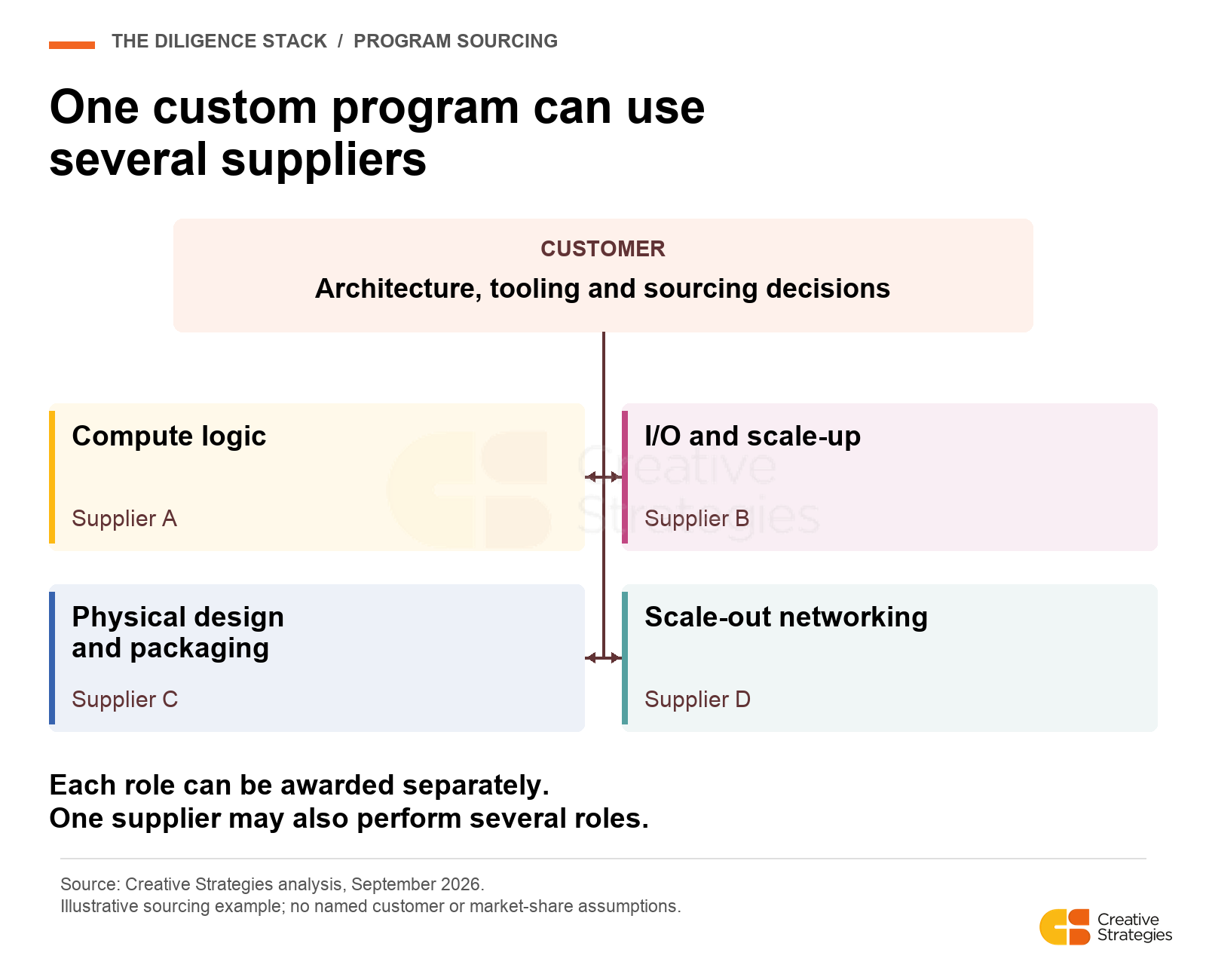
How to read the visual: the customer assigns responsibilities across the program. Each box can go to a different supplier; one vendor may also fill several roles. This is a sourcing example, not a disclosed customer design or an allocation of market value.
A larger opportunity still requires program-level diligence
Our 2028 base case puts the value of custom chips and the networking used with them above $350 billion, with a stretch case above $400 billion. Those figures include the estimated value of chip development done inside companies such as Google and Amazon, so they are larger than the revenue outside suppliers would report. We model supplier revenue separately. We also exclude networking used with off-the-shelf GPU systems. The full report explains how different growth and networking assumptions affect these estimates.
Suppliers can earn more gross profit from a growing market even if they receive a smaller share of each customer’s spending. Profit could exceed our estimates if customers buy more of their higher-margin products. Revenue growth from buying components on a customer’s behalf adds less profit because much of that money goes to other suppliers.
As customers choose suppliers for their next designs, we will look at who supplies the compute, interfaces, packaging and networking. Accelerator sales can meet expectations while supplier earnings differ considerably, depending on which parts of the system each company provides.
Inside the Full Report
The five wallet layers that show where front-side, compute, back-side, I/O, and network value can accrue.
A vendor capability map covering Broadcom, Marvell, MediaTek, Qualcomm, Intel, AMD, GUC, and Alchip.
The base, high-attach, and stretch cases, with the assumptions that bridge custom logic and networking.
Broadcom’s modeled logic allocation and the sensitivity of its total-program share to networking participation.
The proof milestones and customer sourcing behavior that would change our view.
What has changed since April, why MediaTek leads our incremental conviction, and how program mix affects valuation.
Full companion deep research pack in CS Atlas for subscribers to dive deeper with this report.
