


Want to go deeper on Credo and the full interconnect market? In CS Atlas, you can work through our research on its technology, competitors and growth opportunity, then ask your own questions. What does DustPhotonics add? Where could linear optics or CPO change the business? What growth and cash margins would justify the valuation?
Our interconnect SWOT is also available in CS Atlas, where subscribers can explore how we assess Credo alongside its competitors. In our July scorecard, Credo received our highest score for current-cycle strength, its role in addressing key connectivity bottlenecks, and its opportunity in scale-up systems. This report builds on that work, including why we think owning more of the copper and optical design gives Credo room to grow and what we still need to see as those products reach customers.
The companion research is available to subscribers with CS Atlas access.
We will have full coverage of AI Infra Summit in Atlas as well this week so check CS Atlas later in the week for our event notes.
Why we are positive on Credo
We are big believers that vertically integrated companies have more sustainable competitive advantages than their less integrated peers. This is a key reason we have been positive on Credo from the start, and while management consistently articulates this, we still think it is not given enough weight in the analysis of Credo’s competitive position. While Credo still has a lot of runway in its AEC and ALC businesses, we think the market is undervaluing what DustPhotonics adds as interconnect designs move toward NPO, CPO and scale-in.
DustPhotonics gives Credo control of the photonic chip alongside its own SerDes, optical DSP and firmware. We think owning the SerDes is an important part of this advantage because Credo can optimize how the electrical signal is sent and received as it works through the optical design. When a customer needs a connection to use less power, its engineers have more choices about where to make that improvement and how to balance it against reach and reliability. They can work across more parts of the electrical and optical parts together, including how a change in one affects the other. We think that flexibility becomes more valuable as customers move to new architectures and look to integrate heterogenous compute diversification, giving Credo more ways to meet their requirements and compete for the next design.
We also think Credo’s position as a connectivity-focused company with both copper and optical products deserves more weight than is given. Several competitors are stronger on one side of that market, while broader platform suppliers approach connectivity as part of a larger system. Credo can work with customers on where copper still makes sense and where optics is needed, including deployments that use both. That gives it more ways to stay involved as the customer’s architecture changes, without needing every connection to move to optics for the business to grow.
The same flexibility applies when the customer needs a more reliable connection or encounters a problem during qualification. Credo has more of the design available to investigate and adjust, including how it works with the customer’s switches, network interface cards and software. That also gives it more options when working through a production issue with manufacturing partners. If the solution requires changing both the electrical and optical design, the work can be coordinated inside the company rather than across separate suppliers and development schedules.
Helping a customer get to market faster is one benefit we expect from that control and one regularly highlighted my management. The customer may also get a product better suited to its power and thermal requirements, or have less work to do resolving problems in qualification and operation. What the May DustPhotonics acquisition gives Credo is more ability to make those tradeoffs across the full connection, and we think that will matter as customer requirements change from one design to the next and vary across many bespoke rack scale designs, as is the industry trend. That is the broader competitive advantage we see in its vertical integration. Credo acquisition announcement
Winning more of the customer’s business
Credo’s current electrical/connectivity relationships give it a way to bring this broader set of capabilities to customers whose systems are already familiar. This is another element that favors an integrated approach in that it creates the environment for more customer co-design and less likely to be designed out. By covering many parts of the complete solution Credo can extend from the cable to optical components and complete transceivers, depending on what the customer needs help with.
There are good alternatives in both cases. Broadcom and Marvell have substantial electrical and optical capabilities, and established module makers have experience getting products through manufacturing and into customer deployments. Some buyers will prefer separate suppliers because that makes parts easier to change. Others may benefit from having more of the design and support with one company, particularly when power, reliability and the deployment schedule have to be worked through together. While we recognize the option of flexibility, our extensive work analyzing the supply chain consistently lands on the observation that customers prefer a simpler supply chain when possible and “one neck to choke,” meaning a single source with more of a total solution is preferred more often than not.
Exhibit 1. Credo can do more of the work inside the connection
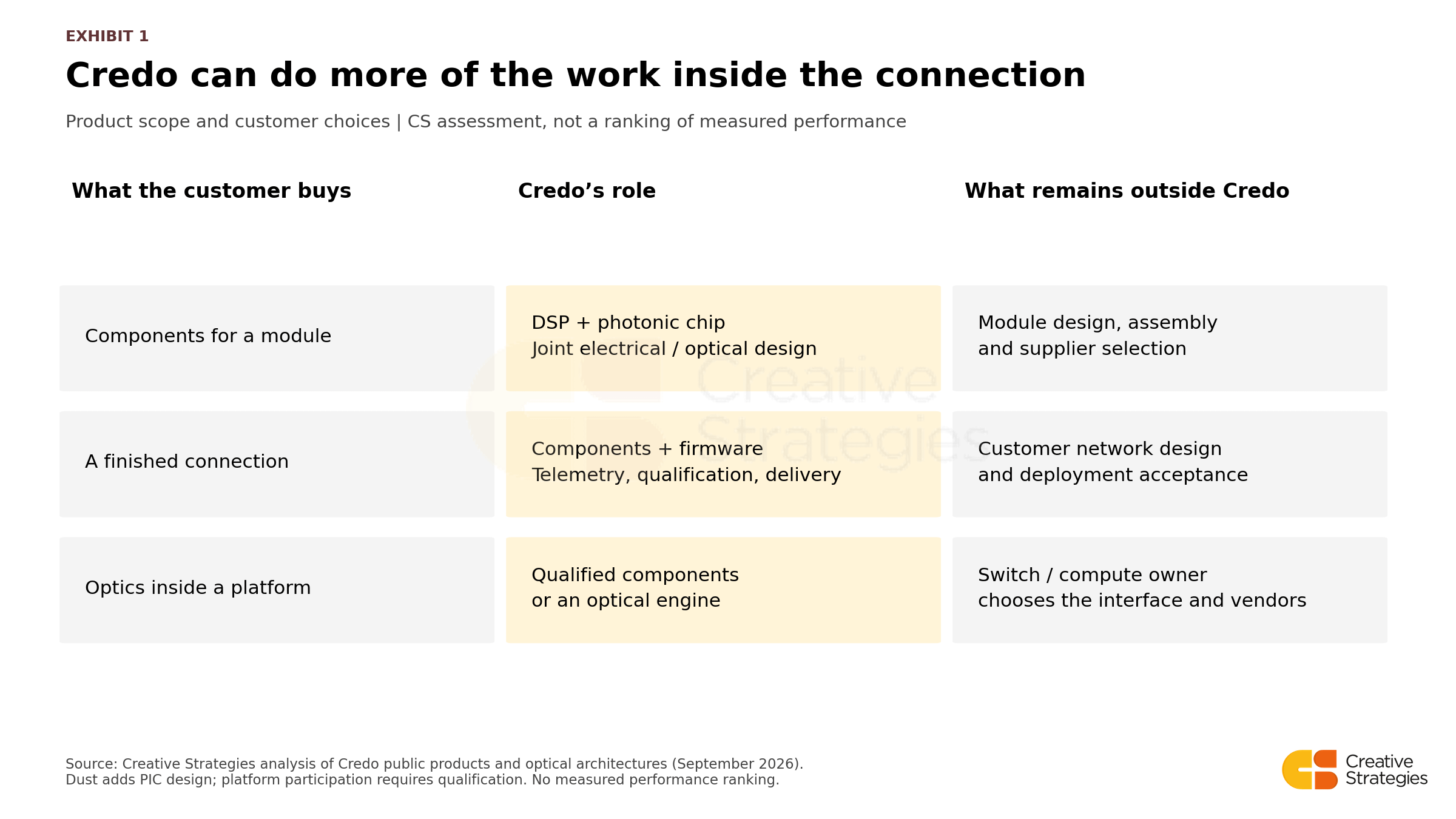
Source: Creative Strategies analysis of Credo’s public product portfolio and optical architectures. The map describes product responsibility, not measured competitive performance. Platform participation remains subject to qualification.
Our expectation is that having more ways to meet the customer’s requirements makes it a stronger competitor for the connections that remain open to outside suppliers. Time to market is one reason a customer might choose it; the ability to keep improving the product with that customer is why we think the advantage can last.
How much growth follows?
Our proprietary accelerator and networking models help us better estimate this dynamic. More accelerators, and in particular higher density of accelerators, create more demand for connections, but the number of units is only part of the equation. As systems spread within the rack and across racks, the distance between parts of the system and the bandwidth they need also change. Copper may still make sense for the short links, or dedicated ones once optics intra rack is reliable enough. And its already established optics serves the longer distances. We expect opportunities for both, rather than one date when the industry moves everything to optics. More in our report on optical timing scenarios below.

We envision a scenario where Credo could grow faster than accelerator deployments as the totality of their solutions get higher attach in rack scale builds. Our models let us test how much those assumptions matter, while keeping bandwidth growth from being counted twice. We also have to distinguish selling a component from selling a complete module. The module brings more revenue, but Credo has to pay for more hardware, inventory and support, so a bigger optical business does not automatically mean a higher company margin.
We are less certain about the pace of that ramp than we are about Credo’s position going into it. Qualifications can take longer than expected, manufacturing output can be uneven and customer schedules can move. Over the next year, we want to see repeat orders turn into gross profit and cash. Our view is that Credo is well positioned to win more business, with a path to growth that could justify its valuation. How quickly it gets there, and how much it earns along the way, are the parts we outline in our house view of Credo.
Inside the full report
What DustPhotonics adds. How joint electrical and optical design could improve power, reliability, qualification and delivery—and where manufacturing dependencies remain.
Where Credo can win. Why customers might choose Credo over Broadcom, Marvell or established module suppliers, depending on what they’re buying.
How optical changes affect the business. What Credo could gain or lose as customers adopt linear optics, NPO and CPO.
The case for outgrowing deployments. Our accelerator and networking models test how content, share and delivery assumptions affect calendar-2028 optical revenue and gross profit.
What would justify the valuation. Growth and cash-margin scenarios through FY32 show what could support the September 11 valuation—and what falls short.
What changes our conviction. The orders, design wins, margins and cash conversion that distinguish a lumpy ramp from a weaker thesis.
Go deeper in CS Atlas. The companion, Credo and AI Interconnects: Technology, Competition and Growth, includes technical detail, competitive comparisons, full optical assumptions and 20 investor questions. Readers with Atlas access can explore those assumptions and ask their own follow-ups.