


This report draws on Creative Strategies’ proprietary models, company intelligence, forecasts, and research corpus. Atlas stores the supporting evidence and tracks changes to our view over time.

In March we published our full primer on the transition from copper to fiber. We were clear then, that this transition takes time and NPO would be a primary driver before CPO with LPO/pluggables still the most mature segment and not going away any time soon. Today’s report goes deeper on the manufacturing challenges that will continue to more accurately inform the timeline of adoption of higher optical content per rack specific to NPO and CPO.
We have spent the last few weeks catching up with friendlies across the optical supply chain. The move toward NPO, CPO, and optical I/O still feels like the Wild West. Architectures remain unsettled, and each vendor still requires highly specialized co-design work. That lack of standardization is the clearest sign of an immature manufacturing ecosystem and makes timing and likely winners much harder to predict.
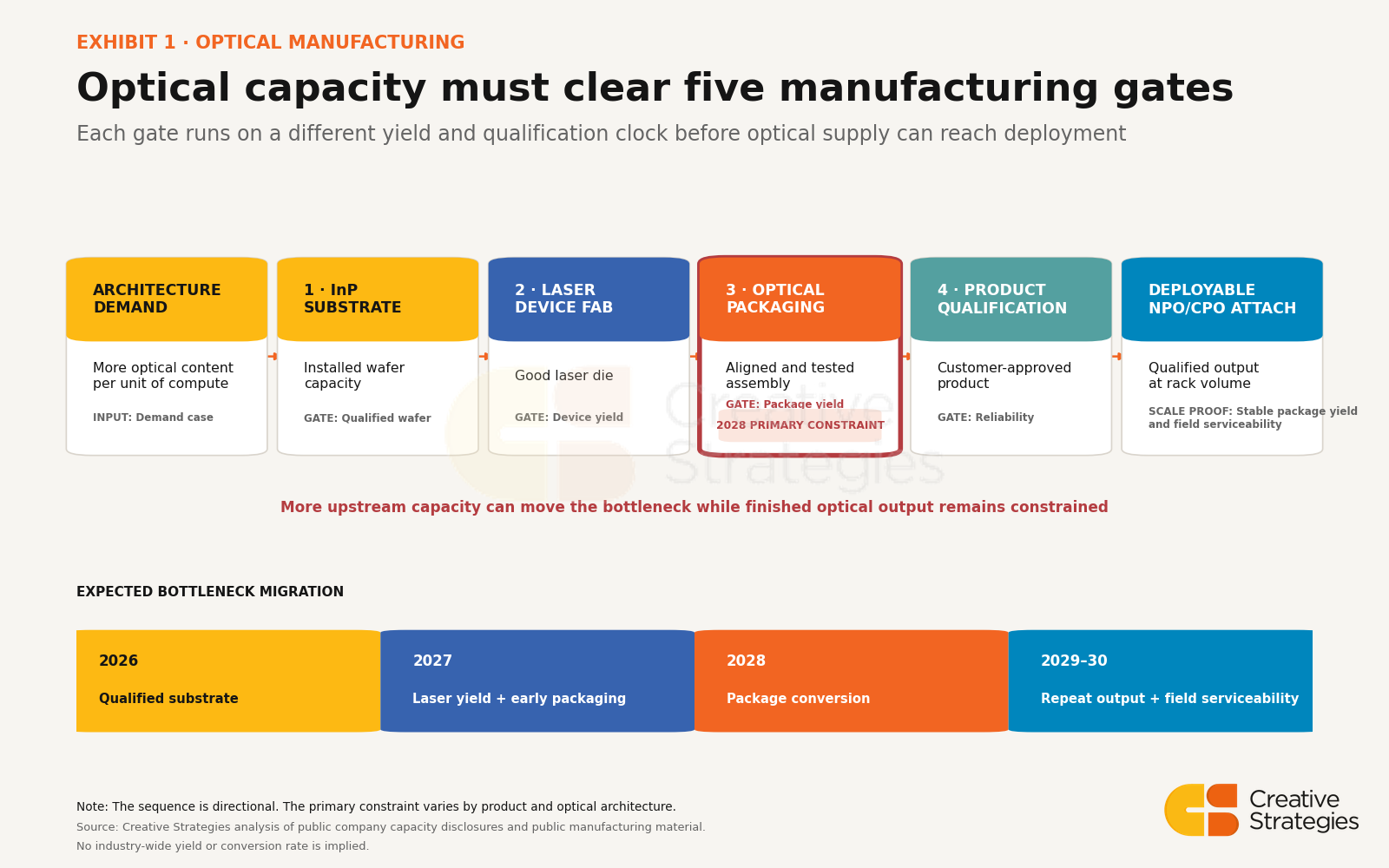
One constant thread has persisted through every conversation. Manufacturing will set the pace of optical attach through at least 2028, and potentially longer. Network architecture and compute roadmaps already point to more optics per unit of compute. The industry will try to adopt these architectures faster than suppliers can produce qualified systems, so qualified output anchors our timing and exposes forecasts that convert demand directly into shipments.
Absent a major manufacturing breakthrough, the constraint should move through the supply chain in a clear sequence. New InP capacity raises the upstream ceiling first. As good laser die increases, precision packaging becomes the next manufacturing challenge. Most AI racks already contain optical links, so optical presence tells us little about increased adoption. We track how much connectivity per deployed rack moves beyond pluggable modules into NPO or CPO. Pluggables remain the more mature, lower-risk path and may persist longer than many want to admit. NPO and CPO can lower power per bit and raise bandwidth density, though their system-cost advantage, and reliability, still has to be proven at scale.
Our model first estimates the incremental NPO and CPO links supported by 2028 network demand. Manufacturing constraints allow about 60% of those links to ship in our base case. This means, for every 100 incremental NPO/CPO links the architecture could support, roughly 60 are realized in 2028. The balance remains on pluggables or moves into later years. We see the larger conversion step in 2029, after new laser capacity has had time to qualify and package output becomes repeatable.
Capacity arrives before qualified output
Our work across public disclosures and supply-chain conversations kept turning up the same gap between installed capacity and usable supply. Capacity announcements usually measure wafer starts or installed equipment. Customers, however, buy qualified optical products. Performance depends on maintaining a low-loss light path across materials that expand differently as temperature changes and the package ages. The substrate has to meet the laser maker’s specification before the device fab can produce good die at repeatable yield. Those die still have to survive packaging and system qualification. Each stage runs on its own timeline, so finished output can remain constrained as physical capacity rises.
The move to 6-inch InP wafers is one attempt to raise the upstream supply ceiling. Larger wafers can produce more die per run once yields settle. Crystal uniformity, process transfer, and customer qualification take time, so we treat 6-inch capacity as the start of the supply ramp. Finished supply comes later.
Coherent has started 6-inch production. Lumentum’s Greensboro facility is scheduled to begin ramping in mid-2028, leaving limited time for qualified shipments that year. We treat 2029 as the first year these additions can support broader attach and will update that assumption as shipment evidence improves.
Packaging becomes the next challenge
More substrate and good laser die can move the manufacturing challenge downstream into packaging without producing the same increase in finished units. Lasers must be aligned to a lens or waveguide with very little loss. Some optical assembly flows still rely on manual or operator-assisted steps, particularly where package designs remain custom. Higher-volume lines can automate active alignment, though automation does not remove the cycle time. Precision equipment still has to measure optical power, move the component into position, and fix it in place for every package. More good die can therefore expose a packaging bottleneck instead of translating directly into finished units.
Manufacturers test again after assembly because bonding and thermal stress can shift the optical path. If the completed package fails, the working components inside it may become unsellable or require costly rework. NPO and CPO concentrate more component value in each assembly, making finished-package yield the better measure of usable optical supply.
Optical attach also moves at different speeds across the network hierarchy. Scale-across already requires optics, while scale-out uses pluggables as the volume base today. The larger incremental content opportunity sits in scale-up as optics moves closer to the accelerator. Our base case moves inter-rack links first because bandwidth is concentrated into fewer optical connections at the rack boundary. Broad intra-rack adoption comes later because it spreads optics across many more endpoints, multiplying the package output that must reach repeatable yield and making failures harder to service inside the rack.
Public disclosures point to early inter-rack CPO activity in 2027 and new laser capacity beginning to ramp in mid-2028. We use those milestones as timing anchors. Our model concentrates incremental NPO/CPO attach in lead inter-rack scale-up systems through 2028. Broader intra-rack attach comes later, after package output becomes repeatable and the manufacturing ecosystem matures.
Inside the full report
A low, base, and high scenario for how quickly NPO and CPO can grow as a share of modeled AI compute-fabric links.
A year-by-year map of the primary manufacturing constraint limiting qualified output.
A pluggable-persistence sensitivity showing how the 2030 mix changes even if manufacturing improves.
Why a laser fab starting in mid-2028 has limited impact until 2029.
A public market map showing who controls each step of the optical transition, including the operating proof required at each layer.
The manufacturing and rack-level proof that would cause us to raise or lower the attach curve.
Company read-throughs for AXT, Broadcom, Coherent, Lumentum, and AAOI, tied to the manufacturing step each controls.
