


The view
In “Bet on Bits, Not History,” we argued that the memory revenue floor is bits at the bottom of the cycle times the price at the bottom, and that the floor has moved several times higher than anything in the industry’s history. Our Micron fiscal Q4 note showed the company-level evidence: customer agreements covering more than 35% of Micron’s revenue through 2030, about $150 billion of remaining performance obligations valued at minimum contract prices, HBM repriced higher for 2027, and no supply relief until 2028. Both notes left one question open. How are valuations being modeled?
Our answer is that the market has moved off history on the level of earnings but still prices more than history on the depth of the next downturn. The three suppliers trade at roughly 5.4 to 6.8 times run-rate earnings, a classic peak-cycle range that says investors expect earnings to fall. Set against our Core Memory model, the multiples also say how far. As a hypothetical, assuming a 40% mid-cycle net margin, Micron is priced for a downturn one and a half to two times the size of the last two cycles, Samsung for one two and a half to three times that size, and SK hynix for one three to three and a half times that size. The gap is widest at the supplier with the most HBM in its revenue, the opposite of what our thesis says the market should be doing.
This note is not a call on when or if a downturn comes or how deep it runs. Memory may be at or near a peak, and among the investors we talk to, the working assumption is that today’s margins cannot hold and that a sharp correction arrives near the end of the decade. Our argument from Part 1 is that the next low will not look like the lows of the past, because the floor has moved. So for the sake of argument, we take each market value, assume a through-cycle margin well below today’s, since we expect memory to give back margin to the rest of the accelerator stack, and ask how deep a downturn the price already implies. The SK hynix gap is also not mainly a disagreement with our forecast. Published consensus earnings for SK hynix in 2028 land close to what our forecast produces at a mid-cycle margin, and the stock trades at roughly four times that consensus figure.
How we read a memory valuation
The analysis runs the valuation backward. We carry each market value forward two years at a 10% cost of equity and divide it by the 12 to 15 times the market would pay for normalized, through-cycle earnings. That gives the normal-year net income the market is capitalizing. We compare it with what our model says each company earns in 2028 at a mid-cycle net margin, and call the revenue shortfall the implied downturn. It is what the price assumes, not what we forecast.
The right comparison is a through-cycle average, not the trough. Memory revenue fell by roughly one-third from 2018 to 2019 and about 40% from the 2021 peak to the 2023 bottom, but average revenue from each peak year through the year before the next peak ran about 19% below the peak in both cycles. We use 19% as the historical benchmark and roughly 38% as a downturn twice that size.
The multiple, the cost of equity, and the margin are our choices, and the margin matters most. For the example, we assume a 40% through-cycle net margin for all three suppliers, well below today’s 70%-plus and well above the losses of 2023, as an assumption for the argument, not a margin forecast. Micron’s own guidance argues for more. Management expects margins at the floor prices in its customer agreements to sit meaningfully above any prior cycle peak, and its net margin at the fiscal 2018 peak was in the mid-40s. That points to 50%, so we show both, and a higher margin deepens every implied downturn below.
Starting well below today’s margin reflects what our accelerator and memory models show when they are run together. In one sensitivity in our forecast, HBM passes half of accelerator package value by 2030, and the memory in each package comes to cost more than its logic. That package is sold by accelerator vendors earning gross margins in the 70s and built with memory from suppliers earning net margins above 70%. We do not think buyers will pay for both for long, so something has to give, and we think it is memory. Accelerator vendors own the platform and the customer and can qualify a second and third HBM supplier each generation, while a memory supplier sells a part qualified into someone else’s platform. The 40% assumption builds that scenario in.
Similar multiples, different businesses
The market is valuing the three suppliers within a narrow band on current earnings.
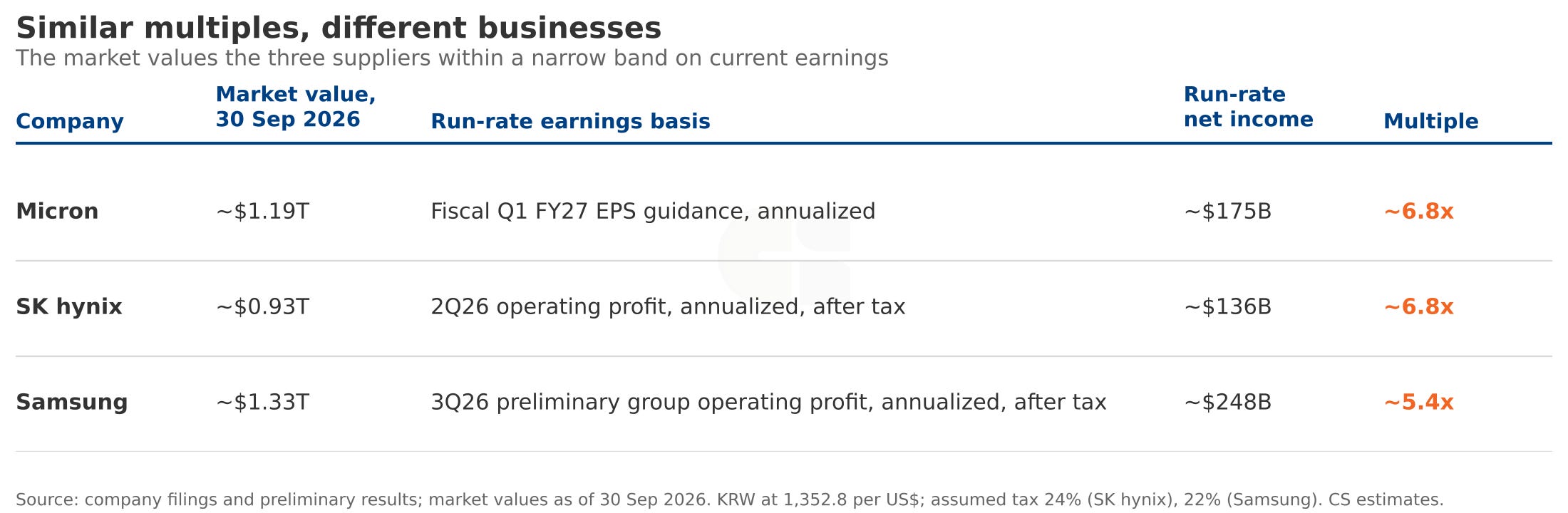
Samsung’s preliminary September-quarter figures, released on October 8, put group operating profit at about KRW 107 trillion on sales of about KRW 195 trillion, up about 20% and 14% from the June quarter and slightly ahead of published consensus. That lowers Samsung’s multiple from about 6.4 times to about 5.4 times, in line with what we expected when this note first ran. SK hynix still annualizes the June quarter and reports late this month, and on current expectations its multiple falls into the same 5 to 5.5 times range. Micron annualizes guidance for the quarter ending November. Samsung’s value also includes foundry, mobile, display, and other businesses, but memory produced almost all of its June-quarter operating profit, and segment detail arrives with full results on October 29. The market is applying one peak-cycle range across the group, which means it is pricing the cycle and not the differences between the companies.
For subscribers, the full note covers:
The normalized earnings each market value supports, and the downturn each price implies at a 40% and a 50% margin
The accelerator and memory model numbers behind our margin assumption
What each stock is worth if the next downturn is half the size of history
Why the market’s ranking runs opposite to HBM mix
Why the next low should sit well above past lows, including our thesis on memory earning on older nodes the way logic does
What would prove us wrong
Subscribe to The Diligence Stack with Atlas to read the full note, with the exhibits and the Atlas companion packet behind it.
