


Before we get into the PC numbers, a quick note on how we built this analysis. Today we are launching the CS Forecast Stack, the connected set of forecast models that sits underneath all of our research at The Diligence Stack and powers Atlas. It is nineteen models (for now) on one shared demand framework, running from fab capacity and compute through data center power and token economics, up to AI revenue and enterprise spend. We built it this way because the AI industry is a chain of dependencies, and this piece is a good example of why that matters for investors and industry stakeholders. A weaker PC market does not stay in the PC market. It frees up leading-edge wafer and memory capacity that data center compute is competing for, and that only shows up clearly when the PC, foundry, memory and accelerator forecasts have to agree with each other. You can see the full forecast stack here.
Semiconductors in the post-device era
For four decades, the semiconductor industry grew on device adoption cycles. PCs, then smartphones, then tablets and wearables each required consumers and businesses to buy new hardware before they could get the benefit of the new thing. Also, importantly, each cycle left behind a larger installed base of connected users. Every prior transformational technology worked this way. Electricity required wiring a home, the internet required a PC and a modem, and mobile required new hardware via a handset, then smartphone. AI is different, and we think it is one of the reasons this cycle may play out differently than the ones before it. The installed base of billions of PCs and smartphones that those cycles built is the distribution channel for AI software, so people can use it today on hardware they already own, with no adoption cycle of new and costly devices to wait for. This is an entirely new dynamic we have not had before with any prior transformational technology where demand is already here we just need the compute that can sustain diffusion at scale. Hence, the build happens in the data center instead, where the compute to serve billions of daily users has to be manufactured, energized and deployed. We think of this as the post-device era: the device cycles set the table, and AI software diffuses across what they built with an economic TAM magnitudes larger than any prior cycle.
That changes what a weak device market means for the industry. In every prior cycle, PCs and smartphones were the wafer volume that filled leading-edge fabs, so a down device cycle hit the whole semiconductor industry. Foundries lost utilization, equipment orders were pushed out and memory makers cut production. A PC downturn as severe as the one under way would once have been extremely bearish.
Today the fabs have a different anchor. Data Applied Materials presented at the opening of its EPIC Center this month shows data center chips rising from roughly 12% of leading-edge foundry-logic wafer starts in 2020 to about a third in 2026, crossing mobile for the first time, and heading toward roughly half by 2030. PCs fall from about a third of leading-edge logic starts to roughly a fifth over the same period. In leading-edge DRAM the crossover came earlier, in 2023, and data center now accounts for more than half of wafer starts. When the fabs are anchored by data center demand that is short of supply, wafers released by a PC downturn do not sit idle. They move to data center compute.
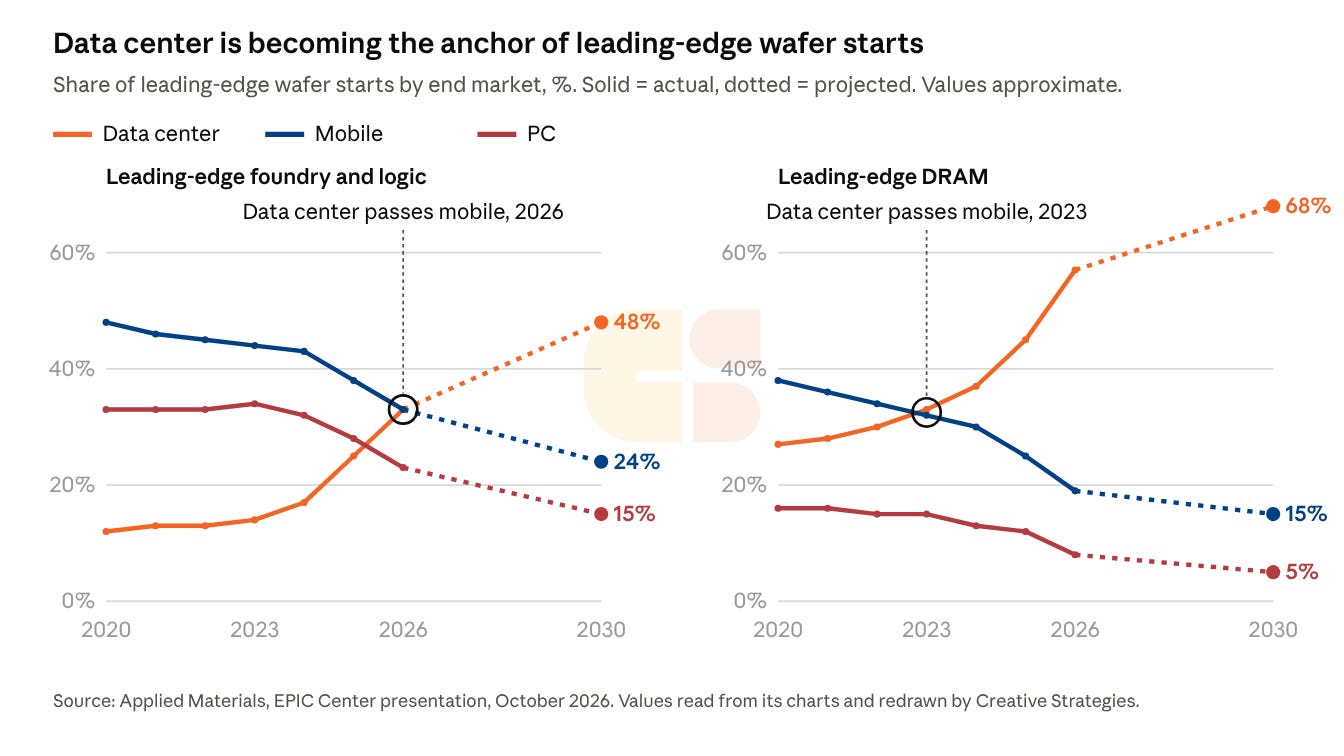
Exhibit 1. Applied Materials, EPIC Center presentation, October 2026; redrawn by Creative Strategies with approximate values.
This report looks at how large that shift could be. The processors, SoCs and discrete GPUs inside a PC sit on the same leading-edge TSMC nodes that AI accelerators and server CPUs need, and a foundry that is sold out on AI work will place released wafer starts with whichever customer is short of supply. So the question we set out to answer is how much leading-edge capacity a weaker PC market actually releases, how much of it can become accelerators and server CPUs that ship to unforeseen upside, and who has the supply chain prowess to use it. Our short answer is that accelerators gain less than the headline suggests, server CPUs gain more than current models assume, and the companies best positioned to capitalize include one most investors would not expect.
In the full report for subscribers:
Our PC forecast for this year and next, plus a downside case where 2027 falls a further 10% to 15%, and why we think the risk sits below consensus.
-The wafer math. How much leading-edge capacity a weaker PC market actually frees, broken out by node and by year, and how much of it can realistically move.
Why accelerators gain less than the headline suggests. Packaging caps the upside in every case we model, so the freed wafers act as supply insurance, not new deployments.
Why server CPUs are the cleaner beneficiary, and how much of the projected server CPU supply gap the freed wafers can close.
Where the rest of the supply chain still has to deliver, from CoWoS-class packaging and memory to substrates and power.
Our ranking of who is best positioned to capitalize, including the one company where we think the market has the PC downturn most wrong.
What would change our view, and the signals we are watching.
