


This report is the third installment in our work on hyperscalers, neoclouds, and the economics of external AI capacity.
We have spent a lot of time tracking power and utilities because we continue to believe power will set the pace of the AI infrastructure buildout. Our recent conversations with industry sources keep coming back to the same problem. We have known about the power bottleneck for some time. What we are hearing now is that it has not gotten any better and, if anything, is getting worse. Data center demand continues to move faster than local utilities can support it. Grid studies can take six to twelve months, and those timelines are getting longer. A new substation can add another two to three years. A company can sometimes move faster if it pays for the substation work itself, but that makes the project more expensive. Even then, the equipment and skilled labor needed to finish the work are getting harder to secure on schedule. Permitting and local resistance can push the timeline out again. Based on what we are hearing, we think the power constraint is likely to stay with the industry through at least 2030 and probably longer.
As we have heard directly from hyperscalers, this timing problem has been shaping how they think about capacity for some time. Demand is coming in faster than utilities and the normal data center build cycle can support. That leaves them using outside partners that already have firm power or can bring a site online sooner.
Calling a company an power/shell/ landlord, neocloud or data center developer only tells us so much. What we care about is whether the site can actually get power and be delivered on time. Where we may differ from many consensus is our belief that the best fit is often a partner that can bring the power and the building online, then stop there. The hyperscaler still controls the compute and the customer, which keeps more of the economics inside its own business.
Amazon and Microsoft will put the capacity gap back in focus
This report will publish during the same week Microsoft reports fiscal Q4 results on July 29 and Amazon reports Q2 results on July 30. We expect both companies to raise the capital-spending bar and show another increase in contracted cloud demand. The labels differ between backlog and remaining performance obligations, but the economic signal is the same: Google (reported), AWS, and Azure are booking demand faster than internal infrastructure can be delivered.
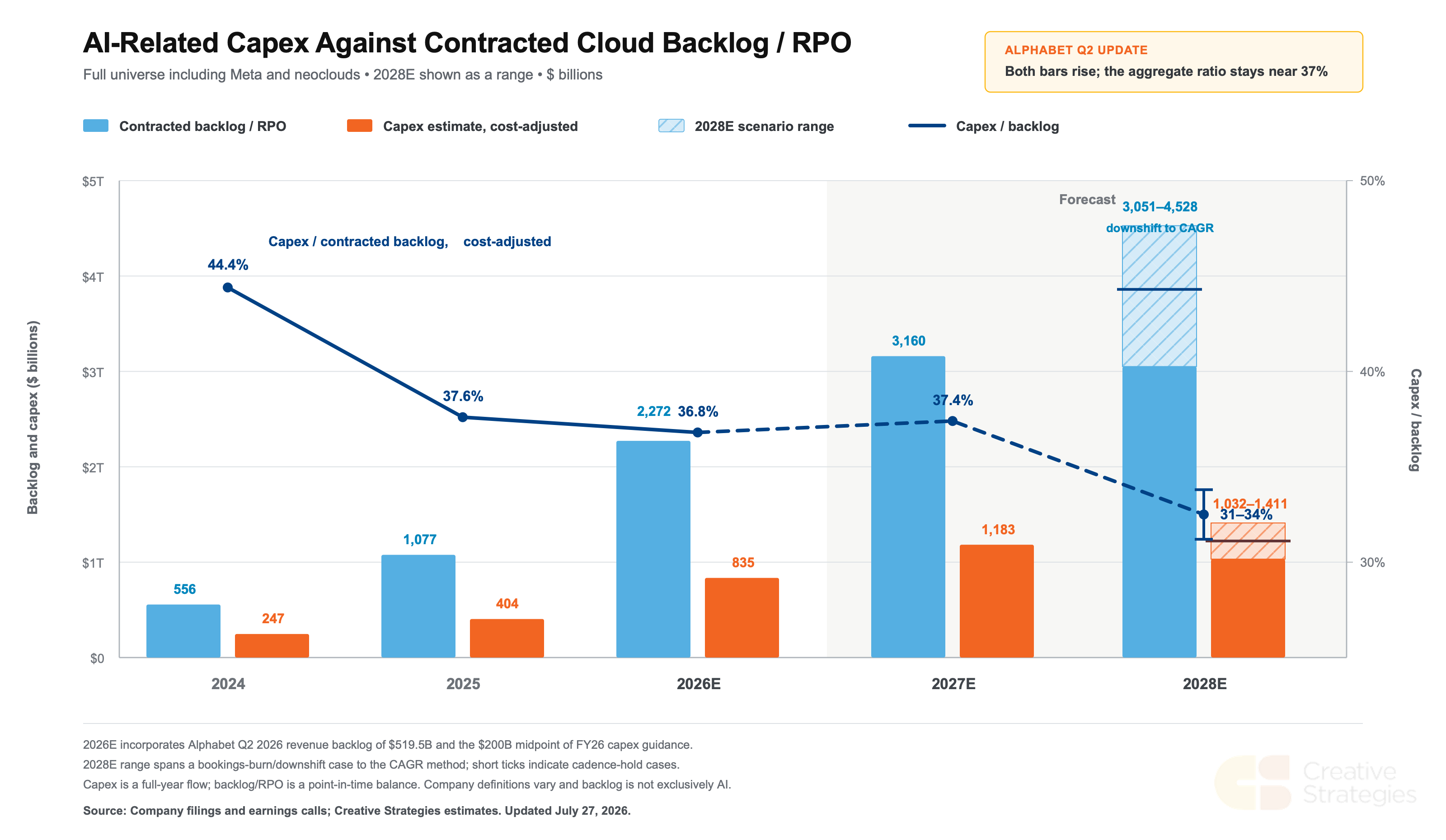
The chart below puts the imbalance on one scale. Across the companies shown (full universe including meta and neoclouds), backlog and RPO have grown faster than cost-adjusted capex. That pulled the ratio from 44% in 2024 to about 37% in 2026. We would not treat this as a measure of physical capacity coverage because capex is an annual flow and backlog is a point-in-time balance. Still, the direction is clear. Contracted demand has grown faster than the capital response, which is why we do not expect capex to slow anytime soon. Key point to remember - revenue always lags capex.
That leaves the economics of the partner as the main question. Hyperscalers will keep using outside capacity while they build more of their own. On Alphabet’s latest earnings call, management called that capacity a bridge and said it would create modest near-term margin pressure. Google is willing to pay the premium because the revenue is available now. Waiting for its own data centers would mean leaving some of that demand unserved. As Google brings more controlled capacity online, part of the premium should go away. The type of partner, and how much of the stack that partner owns, will determine how expensive the bridge becomes. Alphabet Q2 2026 call transcript
Our prior reports looked at the AI cloud from the supplier side. We mapped where hyperscalers and neoclouds compete, then separated neoclouds by the layers they own.


This report looks at the same issue from the buyer’s side. We think AWS and Azure face the same choice Google described. They can, and will, buy outside capacity now and accept some pressure on unit economics, then move more of the workload into controlled infrastructure as their own supply arrives. The question is who is best suited to the hyperscalers are a foundational capacity partner.
That is why we are spending more time on the partner type. A company that secures firm power and delivers the physical layer can remain an attractive partner after the scarcity premium fades. The hyperscaler still controls the server system and the customer. From here, we want to know which providers can deliver the same kind of project more than once.
External capacity is not one product
A complete compute service and a leased data center shell can both deliver capacity, but the buyer is paying for very different things. A managed compute provider supplies the building and the server system, then operates it. The price has to cover the cost of the hardware and the risk that the provider cannot keep it fully used. It also has to cover the chance that the equipment loses value faster than expected. All of that adds another supplier margin to the cost.
A third-party-owned shell stops at the physical layer. The landlord develops the site and delivers a building that can support the required density. The hyperscaler can still own the accelerators and decide how the network is designed. It also keeps the workload inside its own control plane, which is what the hyperscalers generally prefer. More of the cloud margin stays with the buyer, while someone else owns the slow, long-lived physical asset.
This is the capacity hierarchy we are trying to describe. When there is enough time, hyperscalers prefer to own and operate strategic capacity themselves. A leased shell can get them there sooner without giving up control of the compute. Managed third-party compute still makes sense when the value of serving demand now is greater than the premium being paid.
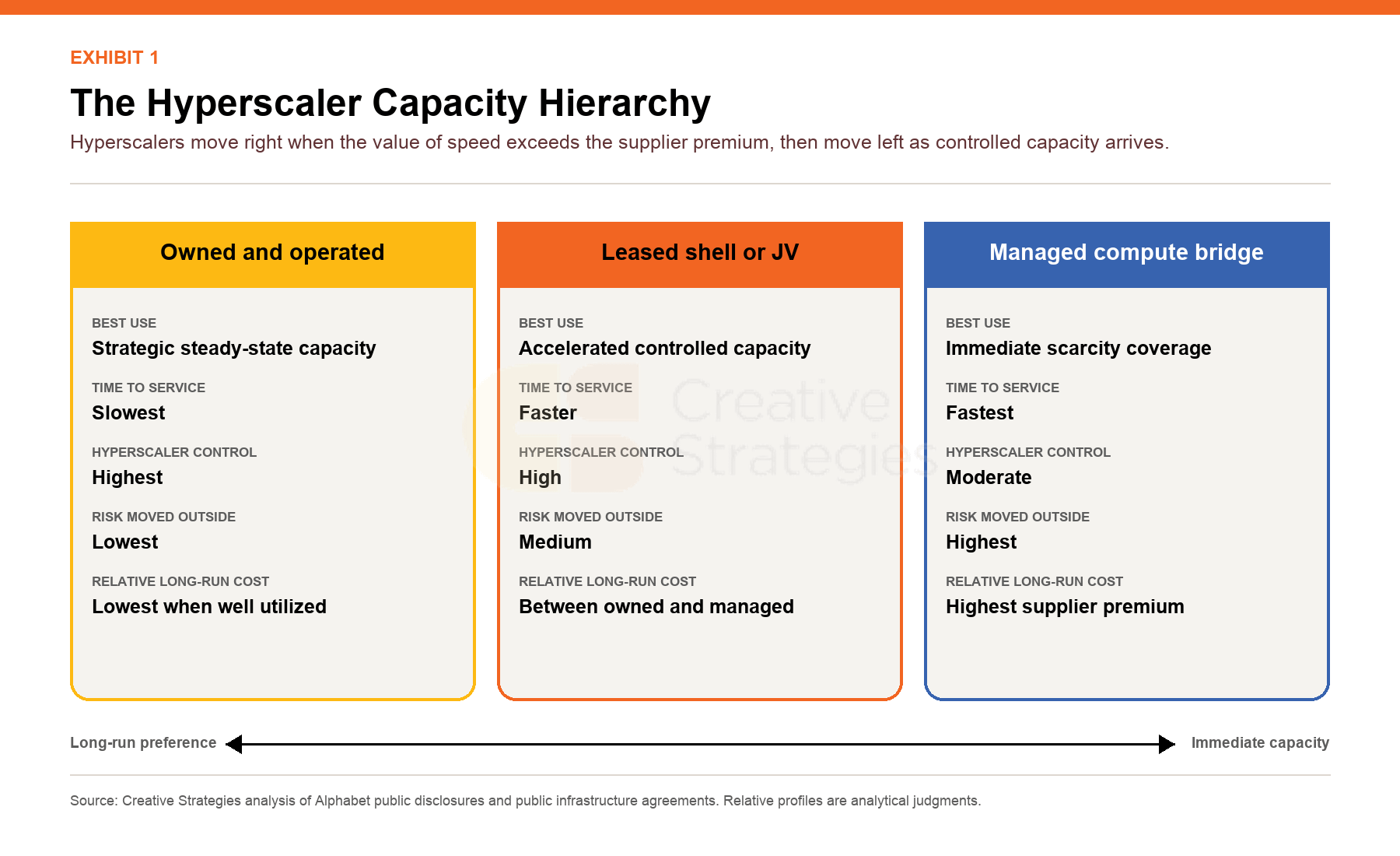
Exhibit 1. The Hyperscaler Capacity Hierarchy. Relative profiles are Creative Strategies analytical judgments, not reported provider margins. Source: Creative Strategies analysis of Alphabet public disclosures and public infrastructure agreements.
The best landlord owns more than land
Power delivery is the known hook making these partners attractive. The latest disclosures help answer the next question: what turns that power into a valuable contract? Applied Digital delivered another 75 MW on schedule, while Core Scientific had 437 MW billing by mid-July against 1.1 GW leased. More important for our thesis, Applied Digital said direct hyperscaler leases should lower its financing cost over the full term. Core Scientific’s mix of direct AMD leases and neocloud leases with AMD protections shows how the risk can change by project. The value sits in converting power into accepted capacity under a contract the market can finance with a specific margin profile. Applied Digital Q4 2026 earnings call Core Scientific Q2 2026 results Core Scientific and AMD partnership
Hut 8 may add another version. The company has leased 704 MW at Beacon Point to an unnamed investment-grade tenant. The Financial Times reported that NVIDIA is the tenant and may sublease the capacity to neocloud partners, although neither company has confirmed it. If accurate, NVIDIA would be securing physical capacity itself rather than waiting for partners to find it. Hut 8 Beacon Point announcement Reuters summary of the FT reporting
Chip vendors may be starting to secure physical capacity themselves. AMD is doing it directly with Core Scientific, while NVIDIA is reported to be leasing Hut 8 capacity that it may place with neocloud partners. The obvious reason is speed, but we think there may be a competitive angle as well. Hyperscalers are putting more custom ASICs into the infrastructure they control. Securing outside sites could help NVIDIA keep scarce power tied to NVIDIA systems before those sites are absorbed into hyperscaler builds. That is our interpretation, not something NVIDIA or Hut 8 has said, but it would expand the buyer pool for the physical layer.
For now, our perhaps out of consensus view, is we still think the best long-term position may sit with the company that controls the physical asset and stops before the compute layer. Hyperscalers will use neoclouds when speed is worth the premium. Chip vendors may now compete for the same sites. All of them still need the landlord to deliver.
Inside the Full Report For Clients and Subscribers
An original model for comparing the cost of delay with the premium paid for managed compute.
A buyer-side margin and capital sensitivity across owned, leased-shell, and managed-compute structures.
Google and Meta case studies showing how the same buyer uses different structures for different time horizons.
A contract-quality ladder separating direct hyperscaler leases from backstopped neocloud tenancy and uncontracted pipeline.
A selected capacity map showing where supply sits, followed by public-company market, beneficiary, and partner-fit maps that separate economic role from announced MW.
A deployable-MW proof ladder and monitoring framework for testing whether announced capacity can become revenue-producing infrastructure.
