


One of our favorite questions from investors and enterprise clients is, “What, if anything, in your view has changed recently?” We think this question requires a lot of intellectual honesty and is a great lens to continue to challenge all our assumptions. Like prior cycles we have studied, a lot has changed and continues to change quickly in this industry. Something we believed strongly earlier in the year may no longer carry the same conviction. Other views held, and in some cases our conviction increased.
We are introducing a new feature called The Changelog. For the time being, we will update it quarterly because this industry changes enough over three months to justify a formal review. It will cover our core theses and the companies we track. It will also cover the micro and macro trends shaping our work. We will explain what changed and why, then identify new theses or areas where our conviction increased.
This regular review will help keep us honest and make industry changes easier to follow. Our research covers the full technology stack, so The Changelog will also give readers a consistent set of mental models they can use across our work.
What this first review found
This first edition covers six months of published research across our broad technology industry coverage. Our conviction in the broader AI thesis remains high and increased in several areas as we studied enterprise customers, their early deployments, and what they learned. We also maintain that demand for compute, and the supply chain around it, will exceed supply for the foreseeable future. At the same time, new evidence changed several views under the broader trend and produced eight new theses.
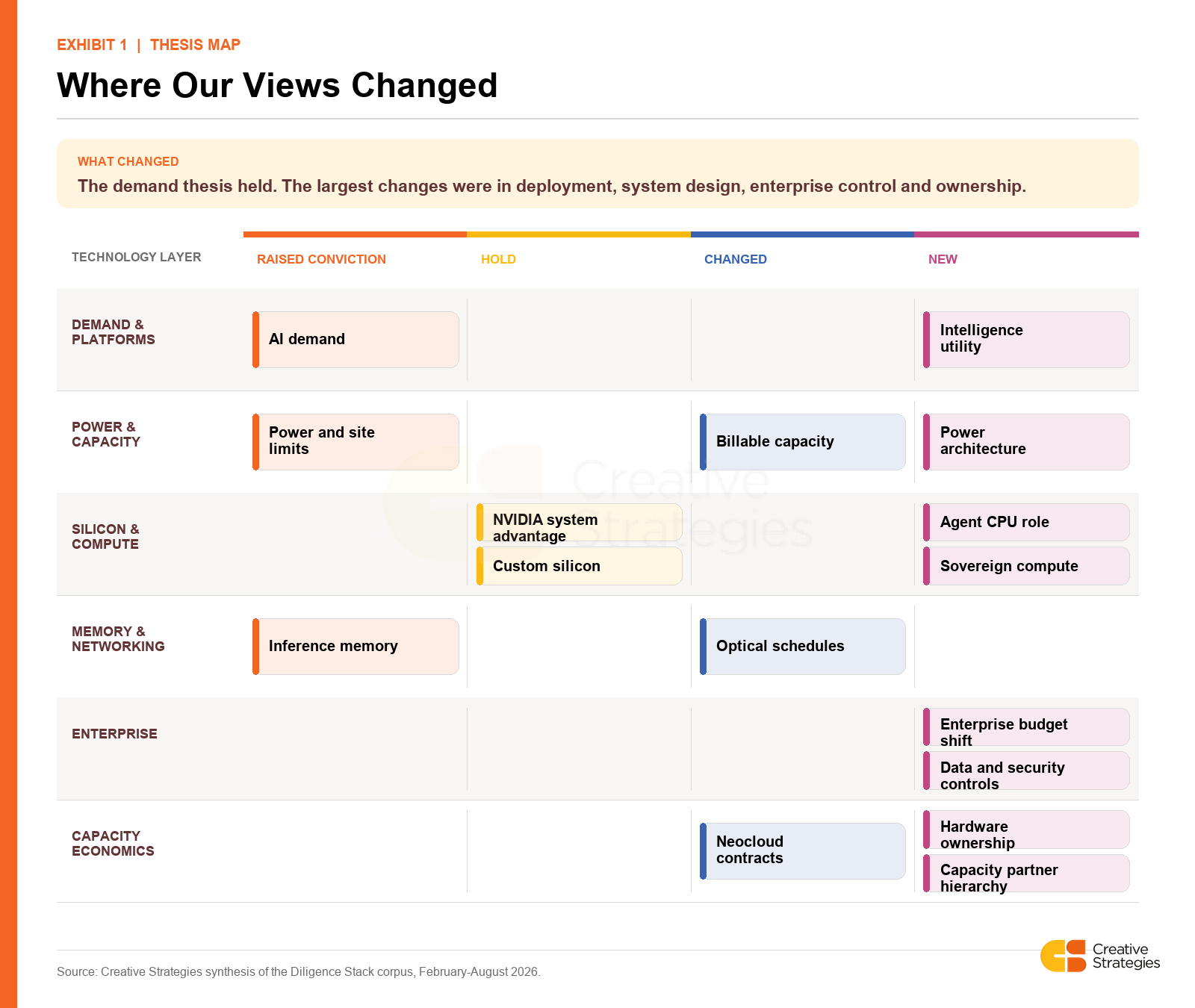
The broad AI demand thesis held across the six months. The evidence changed several views underneath it. Inference raised our conviction in agentic CPU demand, bringing along revived winners as a part of it, and the tension building across memory and networking. Our enterprise work increased our confidence that current adopters are seeing enough ROI to keep spending. Security also emerged as a new thesis as companies focused more on protecting their data and controlling what agents can access.
The thesis map below gives a high-level view of how each thesis moved during the period. Raised conviction means the evidence strengthened an existing thesis, while hold means our view remains intact at roughly the same level of conviction. Changed means the evidence altered the thesis or how we measure it. New means the thesis first emerged during this period, so we start with lower confidence and test it again in future editions.
Inside the full report
The full raised conviction, hold, changed, and new thesis ledger.
Why inference turned the merchant-versus-custom accelerator market into a TCO competition and raised our CPU forecast.
Eight new theses, with the first report, current confidence, and evidence still needed.
How chiplets deepened the advanced-packaging constraint and made Intel’s opportunity clearer.
What enterprise ROI, token budgets, and security requirements now tell us about adoption.
Why bitcoin miners may become better capacity partners for hyperscalers than pure AI neoclouds.
A next-quarter monitoring table showing what would strengthen or weaken each view.