


More from Atlas today. This report pairs with the earnings reads we published on Atlas today:
SiTime Q3 2026: First Quarter With Renesas Timing, and a $1 Billion Run Rate
Coherent Fiscal Q1 2027: A $20 Billion PhotonLink Deal, and a Capacity Build to Match
Arm FQ2 FY27: Licensing Carried the Quarter While Phones Held Royalties Back
Qualcomm FQ4 FY26: Data Center Revenue Starts as Handsets Shrink
The setup: the clock under every AI system
We like companies whose technology represents a shift from analog to digital. When a function moves from an analog part to a semiconductor, it picks up what semiconductors do well. It gets smaller, it can be programmed, it improves with each process generation, and it can be combined with other functions. That kind of shift does more than replace the old part. It brings new capabilities, and it usually opens up a bigger market than the one it replaced. We have been studying SiTime, talking with engineers building next generation infrastructure and spent time with SiTime management and now believe the “timing” is right to share our view of the company and introduce folks to a company and technology they may not be as familiar with.
Deep in nearly every part of computing sits an analog part most investors never think about, the quartz crystal oscillator. A thin piece of quartz vibrates at a precise frequency when voltage is applied, and the oscillator turns that vibration into the clock signal a chip uses to know when to send and receive each bit. Accelerators, CPUs, network cards, switch ports and optical modules all run off one, and the devices that make and distribute that clock are called timing devices. Quartz has done this job well for decades, but it is a cut piece of crystal. Each frequency needs its own cut, higher frequencies need thinner and more fragile crystals, and the part is sensitive to heat, shock and vibration. For most of the history of the data center that did not matter much. A server needed a handful of clocks, the parts were inexpensive, and few people outside the design team paid attention to them.
SiTime sits at the point where timing shifts from quartz to MEMS, a small vibrating silicon structure built with semiconductor processes. That shift opens up new capabilities in compute timing, and the upside gets larger as AI infrastructure, and computing in general, gets more complex. We also like companies that are relatively small today but growing into a much larger market, especially one that the shift itself opens up and expands. SiTime is running at about $1.35 billion a year against a timing market we see reaching $20 billion to $28 billion by 2030, and it checks all of these boxes. Most of the investors we speak with know the AI networking story well, but very few have spent any time on timing, and we think that is a gap worth closing.
AI is what makes timing more critical, because AI workloads no longer run inside one compute box. The race to build larger scale-up domains means a training or inference job now runs across thousands of accelerators that exchange data constantly. Operators want all of that compute to work as one fabric, so a single job can run on GPUs, custom accelerators and CPUs at once, and as power pushes capacity to new sites, it can span buildings and even data centers in different locations. None of that works unless every device is synchronized to the same time, and over time we expect nearly every piece of hardware in the data center to be synchronized.
When devices drift out of sync, the cluster slows down. A frequency jump can make a link drop and retrain, which can stall a job across the whole cluster. More often the cost shows up as lower utilization, and on a cluster of accelerators, lost utilization costs far more than the timing parts do. The requirement also gets harder with each generation, as lanes move to 200G and 400G and PCIe moves to generations 7 and 8. Synchronization, which used to be a telecom topic, is now a design requirement inside AI clusters.
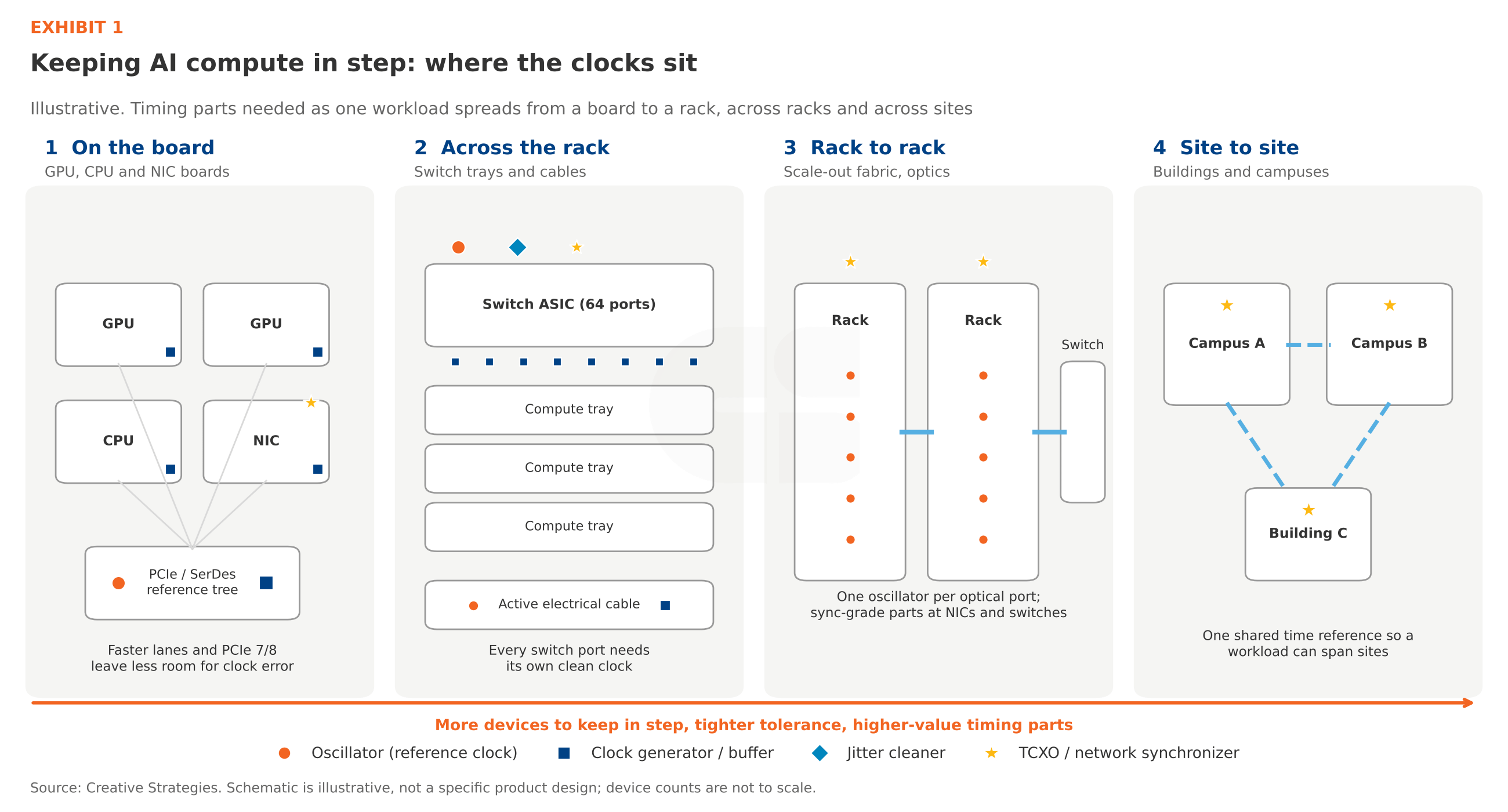
The amount of timing grows faster than the compute itself, because the highest-value clocks sit in the network. In our Base case from 2025 to 2030, accelerators grow about four times, while optical link ends grow about seven times, switch capacity about 16 times and active electrical cables about 15 times. On top of that, content per system is rising: sync-grade parts sell for several times the price of a standard oscillator, the higher frequencies needed for more bandwidth also carry higher prices, and as optics move onto the package, the timing moves from the module to the switch, where designs need several times the content of today’s.
SiTime is the company we think is best placed to sell into that. Because its resonator is silicon and SiTime pairs it with its own mixed-signal circuits, compensation algorithms and packaging, the parts are small, can be programmed to different frequencies, and hold up to the heat, vibration, shock and power noise inside a dense AI rack. They also reach the higher frequencies that 1.6T optics need without the thin, fragile crystals quartz requires. In July SiTime bought the Renesas Timing Products Division, which makes the clock generators, buffers, jitter cleaners and network synchronizers that take the reference clock and distribute it across a system. That gives SiTime nearly the whole timing chain, from the reference clock to every chip, and we do not know of another supplier with a portfolio that covers the full chain in the data center. SiTime reported its first quarter with the Renesas business on November 4 and left the quarter running above $1 billion a year, which we believe makes it the largest pure-play timing company in the industry. We cover the quarter in our SiTime Q3 2026 earnings read.
This report is an introduction to the company and to the timing market for investors who have not looked at either. We size AI data center timing from the bottom up with our own accelerator, server CPU and networking forecasts, and we get to roughly $1.1 billion to $2.1 billion in 2026, growing to $8 billion to $14 billion in 2030, with a midpoint of about $11 billion. That would take AI data center from about 9% of a timing market of about $11.5 billion today to somewhere between 40% and half of a $20 billion to $28 billion market by 2030. That is where timing suppliers will win or lose share over the next five years, and the design wins for the 2027 and 2028 platforms are being decided now.
In the full report for subscribers:
Who SiTime is, how its MEMS timing differs from quartz, and what the Renesas timing business adds to the product line
The four levels where AI needs more timing, from the board to the rack, between racks and between sites
A plain guide to the timing chain, from the reference clock to every chip, and where MEMS and quartz compete for each socket
An attach matrix for an AI rack, showing where each type of timing device sits today and in next-generation designs
Our bottom-up sizing of AI data center timing by layer of the rack through 2030, built on our accelerator, server CPU and networking forecasts
The whole timing market across every end market, and how AI data center grows to 40% to half of it by 2030
Why we think SiTime is well positioned, where the risks sit, and the signals we are watching
Seven exhibits
Companies covered in this report: SiTime (SITM); Renesas Electronics (6723.T); Microchip Technology (MCHP); NVIDIA (NVDA); TXC (3042.TW); Seiko Epson (6724.T); Nihon Dempa Kogyo (6779.T); Kyocera (6971.T); Rakon (RAK.NZ); Murata Manufacturing (6981.T).
Go deeper in Atlas. Atlas subscribers can read our SiTime earnings note and query the accelerator, server CPU and networking forecasts behind this report. Start with one of these prompts:
