


Although The Diligence Stack is still new as a public research product, Qualcomm is not new coverage for us. Creative Strategies has followed the company for roughly 26 years, and we have long believed the data center opportunity represented the next logical extension of Qualcomm's engineering capabilities. Two pieces of history are worth remembering before getting into this report. First, Qualcomm's 2017 Centriq Arm server CPU was widely regarded by many industry contacts we spoke with as technically strong, arriving before the Arm server ecosystem was commercially ready. Today, that environment has been fundamentally validated by hyperscalers. Second, Broadcom's 2017-2018 hostile takeover attempt reinforced our view that Qualcomm's engineering talent, IP portfolio, and technical capabilities were more valuable than the market was giving them credit for.
We attended Qualcomm's Investor Day, spent time with management, and participated in the Q&A with Akash Palkhiwala, Cristiano Amon, and Tony Pialis. We came away believing the data center opportunity is now considerably more tangible than many previously appreciated. Positioning wise, we still view Qualcomm first as a semiconductor engineering company, but data center has become the next platform leg of that engineering story.
Qualcomm used Investor Day to put a different revenue curve in front of investors. The company had already been moving beyond handsets through automotive, IoT, PC, XR, and edge AI, but that version of the story, on the surface, still looked like offset work. Automotive and IoT could help absorb Apple modem loss, Samsung mix pressure, memory-driven Android weakness, and periodic QTL renewal concern. That improved the quality of the business, but it did not force investors to place Qualcomm in a different category.
Chart for visual effect. We detail our entire model and assumptions for each revenue case in the full report and our estimate scenarios carry out to 2030.
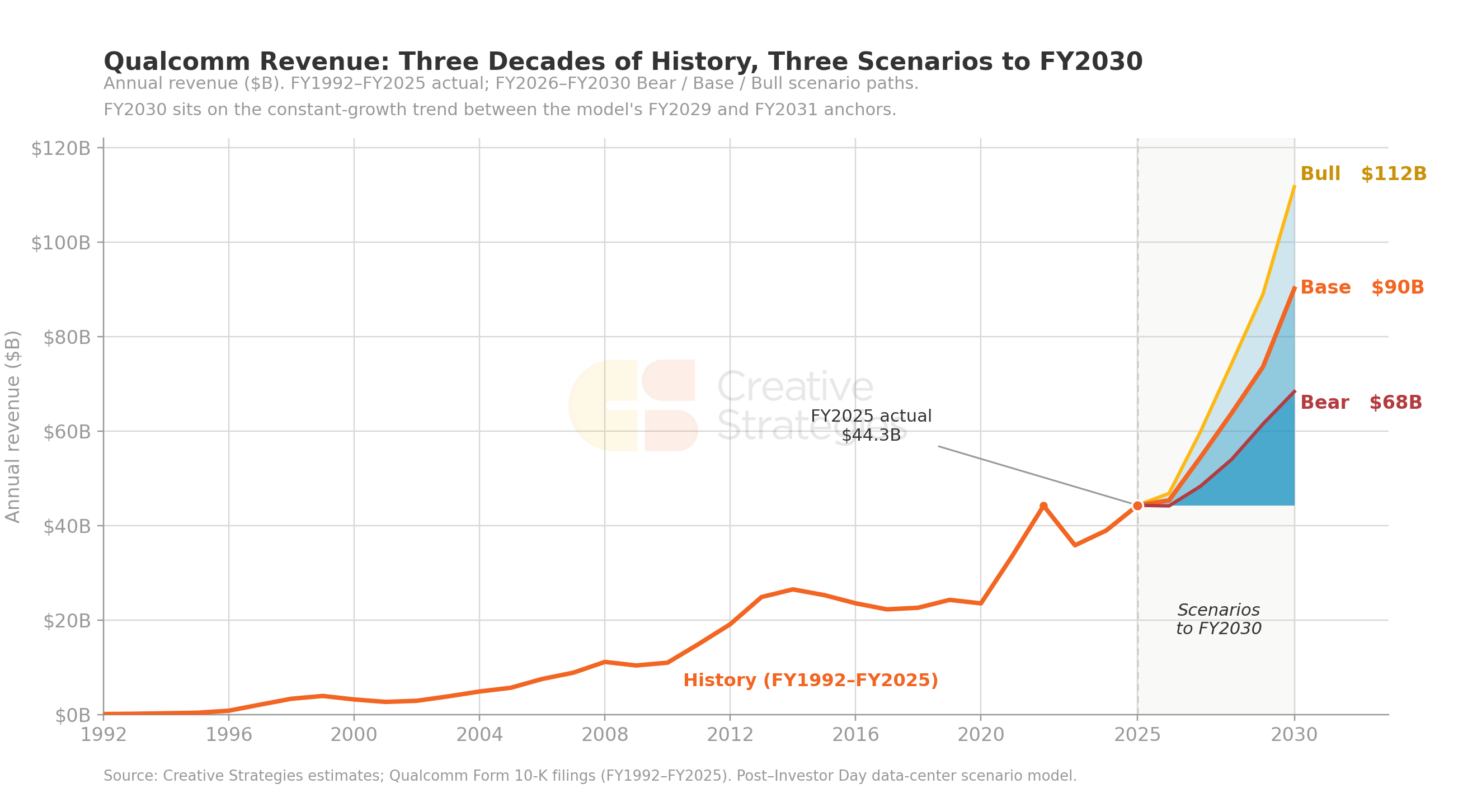
As the chart above visualizes, the data center framework changes Qualcomm’s growth trajectory. Management raised its FY29 non-handset QCT target to $40B, roughly twice the prior FY29 target, and put a more than $15B FY29 data center target inside that number. CFO Akash Palkhiwala also made the mix change direct: by FY29, handsets are expected to fall toward roughly one-third of QCT revenue. That is the cleanest stat from the day on how the diversity story has evolved with data center now in the picture. Qualcomm can still be one of the most important mobile silicon companies in the world, while the investment argument increasingly depends on whether it becomes an edge-to-data-center AI compute platform.
We came away from the event and follow-up Q&A believing the data center narrative is more concrete than many investors assumed going in. The FY27 anchor is custom silicon-led, with two global hyperscale customers each contributing at least $1B according to management’s Q&A comments and both planning multi-generation programs. Qualcomm expects AI250 with HBC Gen 1 to enter commercial sampling in mid-2027, while volume-shipment timing remains undisclosed. C1000 server CPU revenue begins later still. Custom silicon creates the first revenue line, CPU can create a longer hold on the socket, HBC gives Qualcomm an inference architecture of its own, and Alphawave adds the I/O, die-to-die, SerDes, optical, and chiplet assets that support the platform story.
The custom Arm CPU point deserves more attention than it has received. Agentic AI increases host-side work inside the data center because tool use, state management, security, scheduling, and accelerator coordination all run through the CPU complex. A hyperscaler that wants a custom SoC built around standard Arm CPU IP can use Broadcom or Marvell for that path. Qualcomm’s opening is different because its Arm architecture license lets it design the CPU microarchitecture itself as a custom implementation of the Arm instruction set. Oryon, Qualcomm’s mobile-to-auto CPU work, and Alphawave’s connectivity assets give it a credible claim to a more specialized host-platform role.
HBC is the second technical piece to understand. High Bandwidth Compute is Qualcomm’s answer to the inference memory bottleneck. Traditional accelerator systems spend power and packaging budget moving data between compute and external memory stacks. Qualcomm’s approach places the XPU under DRAM stacks so compute sits closer to memory. The company is targeting SRAM-like performance with DRAM-class density, which would improve bandwidth and capacity per watt for suitable inference workloads. We view the architecture as promising and still in need of customer proof. Our industry work shows that near-memory compute has been explored broadly in R&D, and a successful commercial ramp would also make LPDDR a more strategic part of compute packaging.
Our scenario model frames the change. The bear case takes Qualcomm to roughly $61.5B of FY29 revenue with $10B from data center. The base case reaches roughly $73.6B with $15B from data center, using management’s Investor Day anchors alongside our own segment estimates. The bull case reaches roughly $89B with $22B from data center, driven mainly by greater custom Arm CPU absorption and HBC/connectivity attach. Our base case is more constructive than the low-to-mid $40B FY27-FY28 range carried by much of the market. Conversations with management left us with the sense that the public targets were constructed with room for execution, which we treat as supportive primary research and analyst judgment rather than proof of the revenue path.
That is the reason we frame this as Qualcomm’s second platform moment. The first platform was mobile. The second is the attempt to extend Qualcomm’s compute, connectivity, and low-power design DNA into data center AI infrastructure while keeping the edge portfolio compounding. Data center is the growth driver. Automotive, industrial, robotics, personal AI, PC, XR, and QTL make the bridge less fragile. The diligence question is now whether $15B is a ceiling, or the first visible layer of a larger custom silicon platform business.
Inside the full subscriber report
The pre- and post-Investor Day revenue bridge: why the old model looked like offset work and the new model changes the category.
A full scenario model through FY31, including bear/base/bull revenue paths and the EV/sales read-through at each path.
A data center stack that separates custom Arm CPU, custom ASIC services, HBC acceleration, and Alphawave connectivity/IP.
Why custom Arm CPU may be the more lasting upside layer if hyperscalers move beyond standard Arm CSS building blocks.
An explanation of HBC and why its economic value is tied to memory movement, bandwidth per watt, and cost per token.
A full FY29 business breakdown showing how auto, industrial, robotics, personal AI, PC, XR, and QTL contribute around the data center ramp.
What would change our view. The operating variables that would make us more constructive or force us to reduce the data center multiple credit.