


As one would expect a nation state to do, China is treating AI as a matter of national power. The recent model releases are an obvious part of the strategy. Z.ai launched GLM-5.2 and Moonshot launched Kimi K3. Both are built for broad use and for work that can run/reason for a long time. In our Creative Strategies Agent benchmark, which tests models on a range of knowledge work, Kimi K3 performed in the same broad range as several established U.S. models while remaining below the leaders. That result moves the discussion beyond headline benchmark scores. Kimi can already do useful, multi-step work inside a common agent system, which is enough to create demand for Chinese cloud services and computing infrastructure before the country reaches semiconductor parity.
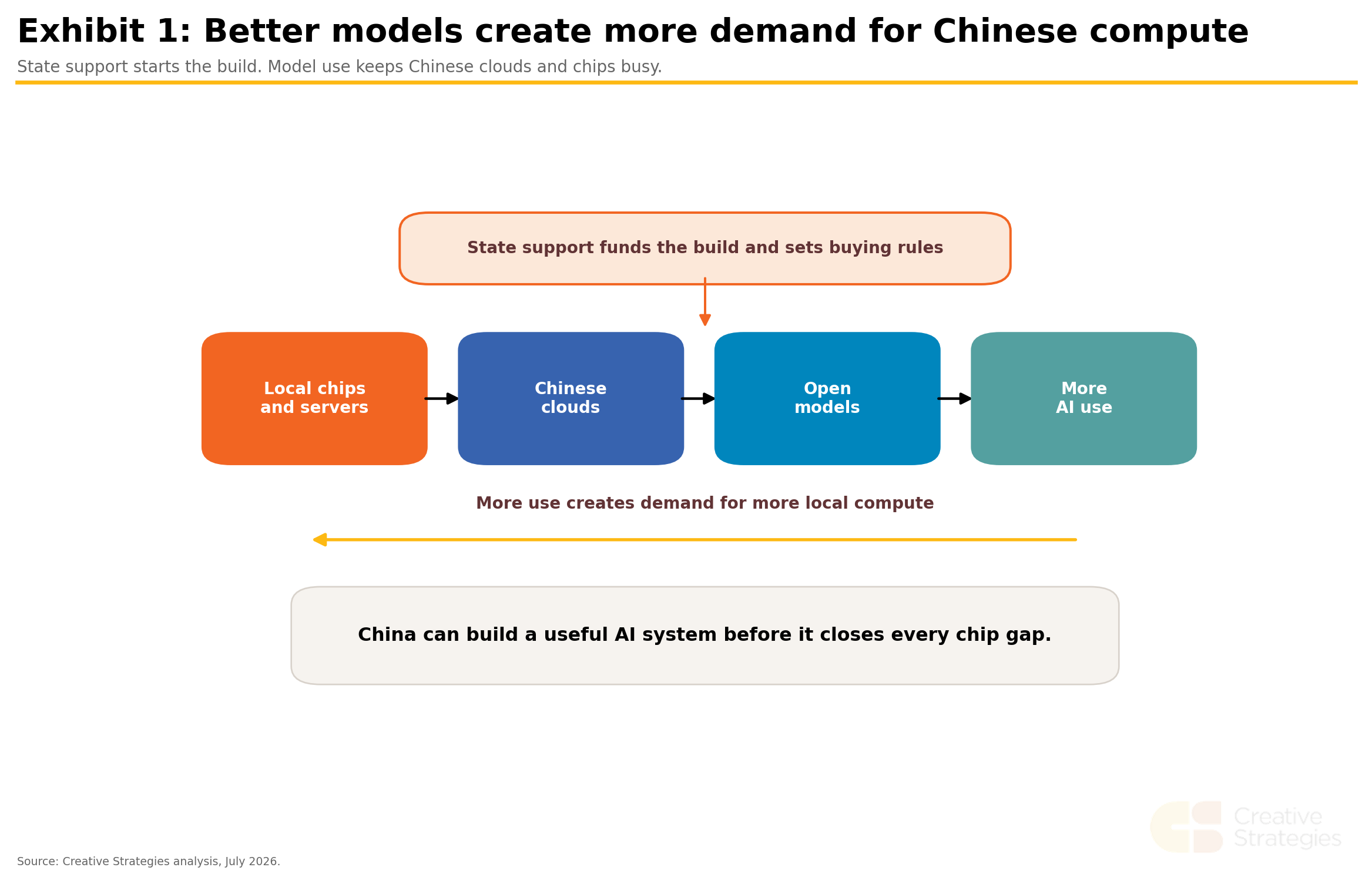
Demand after K3 launched indicates the interest, to at least test and evaluate. Moonshot neared its server limit and paused new subscriptions while it added capacity. A useful model brings more users, and every user adds load to servers and chips. Model progress therefore raises the need for more compute.
We think China sees AI as an arms race between countries. China will not make these decisions only on the basis of near-term financial returns, but they need their AI economy to thrive. The goal is to keep Chinese AI running even if access to outside suppliers is cut off. China will accept higher power use and lower performance per chip if that gives it more control. It may also build capacity before the business case looks attractive.
This is why Kimi K3 and GLM-5.2 belong in a China semiconductor primer. China’s models are improving faster than its chip factories (true of US labs as well to which we estimate AI software is at least two years ahead of hardware and US frontier model labs have to keep meeting hardware capabilities where they are). Each useful model creates more work for Chinese clouds and more reason to make that work run on Chinese chips. Open models can also run outside China, so overseas use may still benefit foreign cloud and chip companies—maybe. Inside China, though, better models create more demand for the local infrastructure below them which in turn helps local silicon roadmaps.
China does not need a chip that matches NVIDIA on every measure. In fact, they may never match leading US chip companies in capabilities. It needs enough local compute to keep its AI work moving if outside supply becomes harder to get. Its largest gaps are advanced chip production and HBM. China also still needs foreign tools to make leading chips. Those gaps are barriers, but they do not stop China from building a useful domestic AI system and economic upside for their local cloud providers.
The full report is our most current read on China compute, infrastructure, and models. We separate the parts China can already supply from the choke points it still cannot replace, then ask what would prove the local stack works at scale. Which is a key metric we are tracking.
Inside the full report
A layer-by-layer map of where China can rely on local semiconductor supply and where foreign tools still set the limit.
A China-versus-U.S. heat map for server CPUs and AI accelerators, including where Hygon and Huawei Kunpeng change the local picture.
How Huawei’s full-system approach compares with independent accelerators and custom chips built by China’s largest internet companies.
How China can use more chips to make up for weaker performance, and whether local switches and optical links are strong enough to support the larger system.
Why Kimi K3, GLM-5.2, Qwen, and DeepSeek can create demand for Chinese infrastructure even when the models are open.
Our planning ranges through 2030, the proof points we are watching, and the evidence that would make us change our view.
